Why Is My Business Website Not Generating Enquiries?

A business website is often built with one commercial job: make the company credible enough that the right visitor starts a conversation. If enquiries are missing, either the right people are not arriving or the site is not giving them enough clarity and confidence to act. This guide focuses on service businesses and B2B sites where the primary conversion is a call, consultation, quote or form rather than an online purchase.
Table of Contents
- Do Not Start With Cosmetic Changes
- Traffic Quality and Message Match
- Clarify the Value Proposition
- Content Depth and Search Intent
- Trust and Risk Reduction
- Mobile UX Audit
- Performance and Technical Reliability
- CTA and Form Friction
- Analytics and Funnel Measurement
- SEO and Internal Linking
- Your Sales Follow-Up Can Make the Website Look Worse Than It Is
- Fix the Earliest Leak First
- 48-Hour Triage Plan
- 30-Day Improvement Plan
- When a Redesign Is Justified
- Final Takeaway
- Build Separate Pages for High-Value Services
- Use Case Studies to Explain Capability
- Give Buyers Enough Commercial Context
- Check Every Contact Method From the Customer's Device
- Use Sales Objections to Improve Service Pages
- Lead Quality Should Shape SEO Priorities
- Make the Follow-Up Process Visible
- Final Business Website Rule
- Homepage Traffic Should Be Routed Intentionally
- About Pages Can Support Commercial Trust
- Portfolio Pages Need Context
- Use FAQ Content to Reduce Sales Friction
- Lead Generation Is a Site-Wide System
- Add a Dedicated Contact or Consultation Page
- Use Internal Links From Proof to Services
- Review Mobile Call and WhatsApp Placement
- Keep Lead Forms Connected to the Page Context
- Final Enquiry Rule
- Use a Site-Wide CTA Strategy
- Keep Service Pages Updated as the Business Changes
- Final Lead-System Principle
- Use an Enquiry Quality Review Every Quarter
- Final Principle
- Final Business Lead Check
- Closing SEO Note
- Frequently Asked Questions
Conversion Diagnostic Funnel
| Stage | Question |
|---|---|
| Traffic | are the right visitors arriving? |
| Relevance | does the page match their intent? |
| Clarity | do they understand the offer? |
| Trust | is there enough credible evidence? |
| Action | is the CTA obvious and appropriate? |
| Friction | can they complete the action on mobile? |
| Measurement | are analytics telling the truth? |
Do Not Start With Cosmetic Changes
When your business website is not generating enquiries, isolate the failing stage before changing the theme, colours or animation. Look at source, landing page, device, CTA clicks, form or checkout starts and completions. A redesign can improve a weak experience, but it can also hide the original cause if the team never established a baseline.
Start with one question: what does a qualified visitor need to believe and do before the conversion? Then inspect whether the website supports each step.
Traffic Quality and Message Match
Separate branded, local, commercial service and informational traffic. A blog can increase sessions without producing immediate enquiries. Paid campaigns should be evaluated by lead quality, not clicks alone.
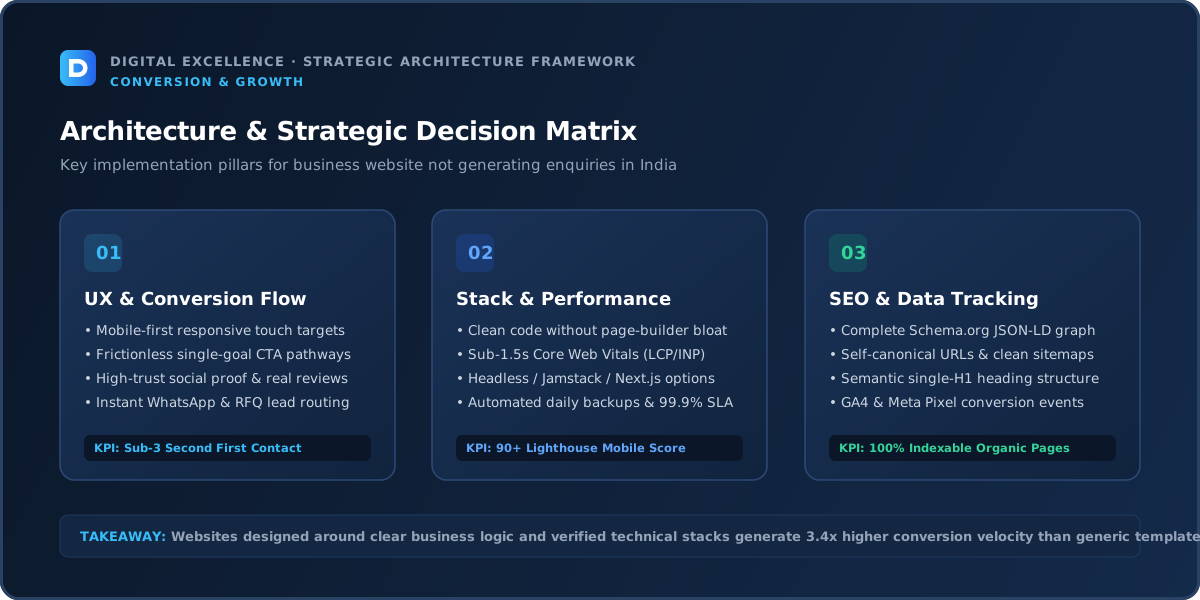
Clarify the Value Proposition
For “Why Is My Business Website Not Generating Enquiries?”, treat clarify the value proposition as a diagnostic checkpoint: compare it with the actual traffic source, landing-page intent and next conversion step before changing the rest of the site.
A visitor should quickly know what is being offered, who it is for and why it is relevant. Avoid headlines that sound impressive internally but require the user to decode the business.
Use the first screen to establish relevance, then support the claim with details, proof and an obvious next step. On mobile, this often means shorter headings, tighter spacing and fewer decorative elements competing with the message.
Content Depth and Search Intent
Each important service should have enough detail to answer a buyer's questions: problem, scope, process, proof, timeline or constraints and next step. If every service is compressed into one paragraph on the homepage, qualified visitors may not have enough information to contact you.
Trust and Risk Reduction
Use relevant work, case studies, real testimonials where available, company/founder information and a transparent process. High-value buyers often need evidence that the provider can handle their specific type of problem.
Mobile UX Audit
For “Why Is My Business Website Not Generating Enquiries?”, treat mobile ux audit as a diagnostic checkpoint: compare it with the actual traffic source, landing-page intent and next conversion step before changing the rest of the site.
Test the journey at 320, 360, 375, 390, 414 and 430px widths. Check headings, menus, forms, comparison tables, galleries, filters, buttons, sticky bars and popups. Nothing should require horizontal scrolling or be hidden behind a fixed element.
If mobile engagement or conversion is meaningfully worse than desktop, prioritise that gap. Do not assume users will tolerate a desktop-first experience simply because the website technically adapts.
Performance and Technical Reliability
For “Why Is My Business Website Not Generating Enquiries?”, treat performance and technical reliability as a diagnostic checkpoint: compare it with the actual traffic source, landing-page intent and next conversion step before changing the rest of the site.
Use Core Web Vitals and real device testing to identify loading, responsiveness and layout-stability problems. Large images, third-party scripts, apps, plugins and animation libraries can all create friction.
Also test the conversion mechanics. Submit forms, try error states, make test purchases where appropriate and confirm notification delivery. Technical failures often masquerade as a persuasion problem because analytics only shows that the visitor disappeared.
CTA and Form Friction
Use clear actions such as Book a Consultation or Request a Quote. Explain what happens after submission and how quickly the team normally responds. Avoid asking for unnecessary data before the first conversation.
Analytics and Funnel Measurement
Track lead source and landing page through the CRM where possible. A channel that generates fewer but better-qualified enquiries can be more valuable than one with a high form count.
For a related diagnosis, see Website Getting Traffic but No Leads? Diagnose These 12 Problems.
SEO and Internal Linking
For “Why Is My Business Website Not Generating Enquiries?”, treat seo and internal linking as a diagnostic checkpoint: compare it with the actual traffic source, landing-page intent and next conversion step before changing the rest of the site.
Search traffic should be evaluated by query intent and landing page. Total clicks can rise while leads fall if growth comes from broad informational terms.
Connect educational content to relevant commercial pages using contextual internal links. Google recommends crawlable links with descriptive anchors. The aim is to help the reader continue their journey, not to force a sales CTA into every paragraph.
Your Sales Follow-Up Can Make the Website Look Worse Than It Is
If leads arrive but receive slow or inconsistent follow-up, marketing may blame the website because enquiries do not turn into revenue. Audit response time, qualification and sales feedback alongside the website.
Use common objections from sales calls to improve service pages. Website optimisation and sales process should inform each other.
Fix the Earliest Leak First
For “Why Is My Business Website Not Generating Enquiries?”, treat fix the earliest leak first as a diagnostic checkpoint: compare it with the actual traffic source, landing-page intent and next conversion step before changing the rest of the site.
Prioritise in this order: broken functionality, irrelevant traffic, unclear value, missing trust, mobile friction, CTA/form friction, performance polish and small experiments. If the first stage is broken, optimising later stages has limited value.
Write one hypothesis for each change and record the deployment date. This simple discipline prevents teams from changing five things at once and then guessing which one mattered.
48-Hour Triage Plan
For “Why Is My Business Website Not Generating Enquiries?”, treat 48-hour triage plan as a diagnostic checkpoint: compare it with the actual traffic source, landing-page intent and next conversion step before changing the rest of the site.
Verify tracking, test the page on mobile, submit the primary conversion, review the top landing pages and traffic sources, and read the page as if you know nothing about the business. Write down the three largest leaks.
Fix obvious technical failures immediately. For messaging or UX changes, prioritise high-confidence changes that can be measured. Do not begin a complete rebuild because of one bad week of data.
30-Day Improvement Plan
For “Why Is My Business Website Not Generating Enquiries?”, treat 30-day improvement plan as a diagnostic checkpoint: compare it with the actual traffic source, landing-page intent and next conversion step before changing the rest of the site.
Week one: measurement and technical reliability. Week two: value proposition, proof and mobile readability. Week three: CTA, forms and high-intent landing pages. Week four: review results and plan the next test.
For low-traffic sites, combine analytics with actual sales conversations and customer questions. Small samples can fluctuate heavily, so use judgement rather than treating every percentage change as proof.
When a Redesign Is Justified
For “Why Is My Business Website Not Generating Enquiries?”, treat when a redesign is justified as a diagnostic checkpoint: compare it with the actual traffic source, landing-page intent and next conversion step before changing the rest of the site.
A full redesign makes sense when the information architecture, CMS, mobile system or technical foundation creates repeated problems. It is less sensible when one landing page, form or campaign is the real issue.
Preserve strong pages, URLs and user journeys. A redesign should remove structural friction rather than reset every element for novelty.
Final Takeaway
A business website generates enquiries when the right visitor finds a specific service page, sees credible evidence and understands exactly what to do next.
Use the website as a measurable system: acquire the right audience, make the value clear, reduce risk, remove friction and verify the conversion path. That sequence is more reliable than adding more traffic or redesigning on instinct.
Build Separate Pages for High-Value Services
If every service is described in one generic block, high-intent visitors may not get enough information to decide whether the business is a fit. Create dedicated pages when services have meaningfully different problems, processes or buyer questions.
These pages can also support more precise search intent and paid campaigns.
Use Case Studies to Explain Capability
A useful case study describes the client context, challenge, approach and outcome using facts the business can support. Even when exact numbers are confidential, the story can show how the team thinks.
This is more persuasive than a gallery of logos with no explanation.
Give Buyers Enough Commercial Context
For customised services, exact public pricing may not be practical, but explain what affects cost, whether there is a minimum engagement or what a typical process includes. Commercial uncertainty can prevent contact.
The objective is not to publish a rigid rate card; it is to help obviously unsuitable and suitable buyers self-select.
For another useful funnel check, read Website Forms Getting No Submissions? Check These 12 Problems.
Check Every Contact Method From the Customer's Device
Tap phone links, WhatsApp, email, booking and forms on real mobile devices. Verify that numbers are correct, forms submit, confirmation appears and messages reach the right team.
A broken contact path can make a healthy lead-generation page appear unsuccessful.
Use Sales Objections to Improve Service Pages
Ask the sales team which questions prospects repeatedly ask before buying. Add concise answers to the relevant pages: timing, scope, support, process, requirements or price drivers.
Website copy is strongest when it reduces real uncertainty rather than repeating brand adjectives.
Lead Quality Should Shape SEO Priorities
If one service produces better customers, build a stronger topic cluster around its buyer questions. If another page attracts traffic but mostly poor-fit enquiries, adjust targeting and qualification.
SEO success should ultimately support useful demand, not only increasing sessions.
Make the Follow-Up Process Visible
Explain when the business normally responds and what the first conversation is for. Internally, assign ownership for every enquiry source and create a fallback when the primary recipient is unavailable.
Lead generation is incomplete until the enquiry reaches someone who can act on it.
Final Business Website Rule
A business site generates enquiries when relevant visitors can understand the service, believe the provider and take a predictable next step. Improve those three conditions before adding more traffic.
Homepage Traffic Should Be Routed Intentionally
The homepage often receives branded and referral traffic with mixed needs. Make important services easy to discover without turning the page into a full copy of every service page.
Use clear category/navigation choices that help visitors self-select quickly.
About Pages Can Support Commercial Trust
An About page should explain the business, relevant experience and why the team is credible, not only tell a long founder story. Link naturally to services and proof where helpful.
For personal-service businesses, the person behind the service may be a significant buying factor.
Portfolio Pages Need Context
Show what type of project it was, what the business needed and which part your company delivered. Images alone may prove design taste but not problem-solving capability.
Avoid unsupported performance claims; factual project context is valuable on its own.
Use FAQ Content to Reduce Sales Friction
FAQs can answer timing, process, scope, support and common objections close to the relevant service. Keep them useful rather than stuffing keyword variants into repetitive question blocks.
If sales keeps answering a new question, update the page.
For the next troubleshooting step, use How to Make a Business Website Generate More Qualified Leads.
Lead Generation Is a Site-Wide System
Navigation, service pages, proof, articles and contact paths should support one another. A single high-converting landing page cannot compensate for a confusing site architecture when buyers research multiple pages before contacting.
Add a Dedicated Contact or Consultation Page
High-intent users should not have to navigate back to the homepage to find the form. A focused contact page can explain the next step, expected response and alternative contact methods.
Use Internal Links From Proof to Services
When a case study demonstrates a capability, link to the relevant service. When a service page mentions a result or project, link back to the proof. This helps both buyers and search engines understand the relationship.
Review Mobile Call and WhatsApp Placement
Fixed contact buttons can help, but they should not cover text, form controls or bottom navigation. Use one clear persistent action rather than several competing floating elements.
Keep Lead Forms Connected to the Page Context
If a visitor is on a specific service page, pass that service into the form or CRM automatically where possible. This saves the user from repeating information and gives sales useful context.
Final Enquiry Rule
The website should answer enough questions that contacting the business feels like the logical next step, not a request for information the page refused to provide.
Use a Site-Wide CTA Strategy
Decide which page types use consultation, quote, call, WhatsApp or another action. Consistent terminology reduces confusion and makes analytics easier to interpret.
Different stages can still have different actions, but the system should feel intentional.
Keep Service Pages Updated as the Business Changes
Old pricing assumptions, discontinued services and outdated process descriptions create poor-fit enquiries. Assign an owner to review commercial pages periodically and after major offer changes.
Final Lead-System Principle
Treat the website, CRM and sales follow-up as one lead system. A strong page cannot compensate indefinitely for lost notifications or inconsistent responses.
Use an Enquiry Quality Review Every Quarter
Sample recent leads and identify which pages and sources created the best opportunities, which common questions remained unanswered and where poor-fit leads came from. Update service pages and forms from this evidence.
Final Principle
A business website should make the right customer more confident about contacting you while helping the wrong-fit visitor recognise that early.
Final Business Lead Check
Make sure every important service page has a clear owner, a real proof element, a relevant next step and tested lead delivery. These basics matter more than adding another decorative homepage section.
Closing SEO Note
Qualified enquiries matter more than raw form volume. Keep service clarity, proof and lead routing aligned.
For implementation options, explore website development services and Digital Excellence portfolio.
Frequently Asked Questions
Why does my business website get no enquiries?
Common causes include low-intent traffic, unclear services, weak proof, contact friction and broken tracking.
Should every service have its own page?
When services have distinct customer intent and enough useful content, dedicated pages can help users and search engines.
Do I need pricing on the website?
It depends on the sales model, but useful price guidance can reduce uncertainty.
Is WhatsApp enough for enquiries?
It can be useful, but track it and provide other accessible contact options.
How quickly should leads be answered?
Set a realistic process that sales can consistently meet.
Should I redesign if enquiries are low?
Only after identifying whether the problem is structural.
Need More Qualified Website Enquiries?
Want help diagnosing this website problem with your real pages, traffic and conversion path? Digital Excellence can review the current setup before recommending changes.