How to Compare Website Development Quotes

Website quotes are difficult to compare because vendors rarely describe scope in exactly the same way. One proposal says “10 pages + SEO + free hosting.” Another says “custom information architecture, five templates and technical SEO.” The first may be cheaper, but you cannot know which is better until both are translated into the same checklist. This guide gives business owners a practical way to compare website development quotes line by line instead of choosing from package names or headline prices.
Table of Contents
- Why This Decision Is More Important Than It Looks
- Compare Unique Templates, Not Just Page Count
- Separate One-Time Work From Recurring Cost
- Mobile Quality Checklist
- SEO and Information Architecture
- Performance and Technical QA
- Ownership and Access
- Recurring Costs and Dependencies
- How to Compare Options
- Common Red Flags
- Pre-Decision Checklist
- What to Measure After Launch
- First 90 Days After Launch
- Final Takeaway
- Normalise Scope Before You Compare Price
- Compare the Number of Decisions the Vendor Is Taking Responsibility For
- Separate One-Time Fees From Third-Party Costs
- Use Exclusions as a Quality Signal
- Compare Revision Processes, Not the Word Unlimited
- Review Payment Milestones Against Deliverables
- Check the Cost of Future Changes
- Final Quote Comparison Rule
- Compare Timeline Assumptions
- Compare Quality Assurance Depth
- Compare Ownership and Exit Cost
- Compare Support Models
- Compare the Quality of the Questions You Were Asked
- Create a Weighted Decision Sheet
- Ask Vendors to Price the Same Optional Features Separately
- Check Whether Tax Is Included in the Quote
- Compare the Cost of Client-Side Work
- Final Decision Conversation
- Create a ‘Same Scope’ Re-Quote if Necessary
- Final Quote Selection Rule
- One Final Comparison Check
- Final Buyer Check
- Frequently Asked Questions
Website Quote Comparison Matrix
| Category | Quote A | Quote B | Question |
|---|---|---|---|
| Unique templates | ? | ? | how many distinct layouts? |
| Content | ? | ? | who writes/uploads it? |
| SEO | ? | ? | exact technical/on-page tasks? |
| Mobile | ? | ? | responsive QA included? |
| Ownership | ? | ? | domain/code/accounts? |
| Support | ? | ? | what happens after launch? |
| Recurring costs | ? | ? | hosting/apps/plugins? |
Why This Decision Is More Important Than It Looks
Website pricing is highly scope-sensitive. The same words can describe different amounts of work, and a low quote can legitimately be excellent if the requirements are simple. Comparison only becomes fair when assumptions and deliverables are visible.
Compare Unique Templates, Not Just Page Count
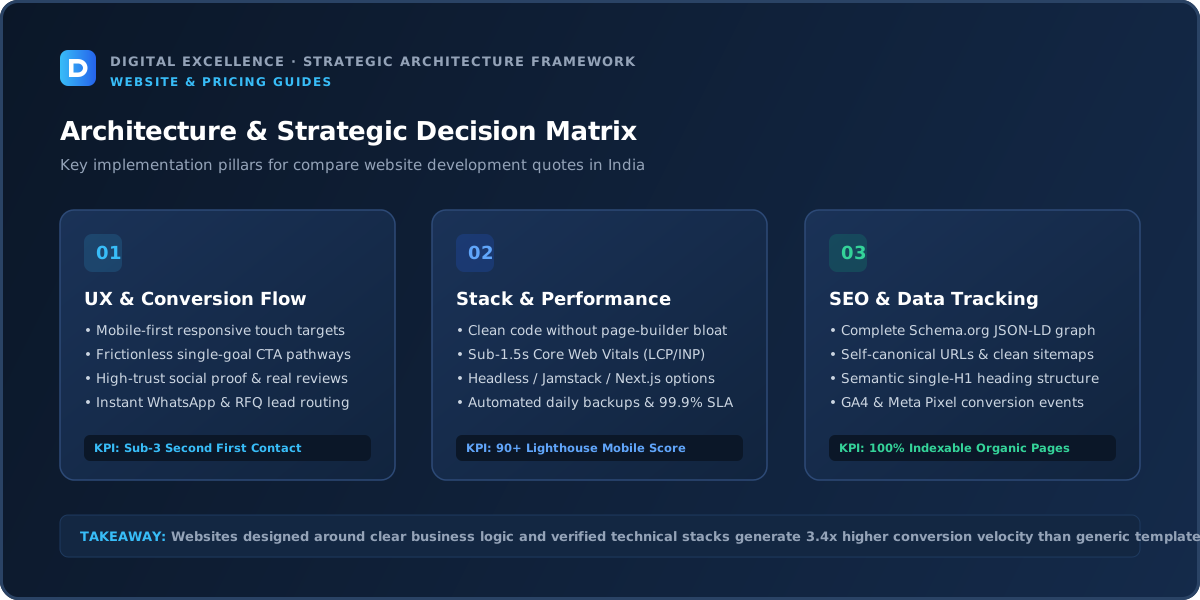
Ten pages can be generated from two reusable templates, while five pages can require five custom designs. Ask which layouts are unique and how repeatable content is managed.
Template count affects design, development and QA effort and is often a better estimator than raw URL count.
Separate One-Time Work From Recurring Cost
A quote may include first-year hosting, themes or apps that renew later. Another may charge less for launch but require a monthly maintenance plan.
Create a year-one and year-two cost view so promotional inclusions do not distort the decision.
Mobile Quality Checklist
A practical check for “How to Compare Website Development Quotes” is whether mobile quality checklist makes the next user decision clearer or the site easier to operate. If not, deprioritise it.
Review the project on real mobile widths, not only a desktop browser. Check navigation, heading size, forms, tables, images, sticky elements and the primary conversion path. The site should remain readable without forcing the user to zoom or dismiss intrusive overlays.
For long-form SEO pages, typography matters too. A developer who can make a 2,000-word buying guide comfortable on a phone is solving a different problem from someone who only creates impressive hero sections.
SEO and Information Architecture
A practical check for “How to Compare Website Development Quotes” is whether seo and information architecture makes the next user decision clearer or the site easier to operate. If not, deprioritise it.
Important pages should have a clear purpose, descriptive URLs, one H1, unique titles and meta descriptions, self-canonicals, sitemap coverage and contextual internal links. Google recommends crawlable links with meaningful anchor text so users and search engines can discover related pages.
If an existing site is being changed, redirects and migration planning must be part of the scope. Technical SEO should be visible in the implementation checklist rather than implied by the word “SEO-friendly.”
Performance and Technical QA
A practical check for “How to Compare Website Development Quotes” is whether performance and technical qa makes the next user decision clearer or the site easier to operate. If not, deprioritise it.
Before launch, test the primary templates for loading, interaction and visual stability. Google recommends good Core Web Vitals as part of an overall good page experience. Performance work should focus on real bottlenecks such as media, fonts, scripts, plugins or apps.
QA should also include forms, validation, error states, analytics events, links and the critical user journeys. A fast page with a broken contact form is not a successful launch.
Ownership and Access
Check domain ownership, hosting or deployment access, CMS administrator access, source repository where applicable, analytics and Search Console. If a vendor manages these accounts, transfer terms should be clear.
Recurring Costs and Dependencies
List hosting, platforms, premium themes, plugins, apps, email, CRM, booking software, maintenance and usage-based infrastructure. Ask which costs are estimates and which are fixed.
For a related buying decision, see Website Development Proposal Checklist: What Should Be Included?.
How to Compare Options
Create one spreadsheet with a row for every deliverable. Add a column for “not specified.” Ask each vendor to fill the gaps in writing. Then review live work and process, not only the revised price.
Common Red Flags
Red flags include guaranteed rankings, vague “unlimited everything,” no ownership terms, large upfront payment with no milestones, portfolio screenshots without live examples and hidden recurring software.
Pre-Decision Checklist
A practical check for “How to Compare Website Development Quotes” is whether pre-decision checklist makes the next user decision clearer or the site easier to operate. If not, deprioritise it.
Write down the project goal, required pages or workflows, platform, content owner, integrations, SEO scope, analytics, migration needs, mobile requirements, revisions, timeline, payment milestones, account ownership, handover and support.
Mark anything not specified as unknown. Unknowns are where budget surprises and disputes usually appear.
What to Measure After Launch
A quote should connect the website to a measurable goal: leads, sales, bookings, content publishing, support reduction or another business outcome. Decide in advance which analytics and conversion events must be implemented.
First 90 Days After Launch
A practical check for “How to Compare Website Development Quotes” is whether first 90 days after launch makes the next user decision clearer or the site easier to operate. If not, deprioritise it.
Monitor technical errors, analytics, Search Console, form or ecommerce events and real user feedback. Fix high-impact issues before adding decorative features.
Use actual queries and conversion data to improve content and internal links. The first version should be a strong foundation for iteration, not a frozen asset that cannot change.
Final Takeaway
Turn every quote into the same scope matrix. Once assumptions are visible, the trade-offs in price, process and risk become much easier to evaluate.
The page should help a buyer make a better decision even if they never become a client. That is the standard for durable SEO content: useful detail, honest limitations, clean structure, contextual links and an excellent mobile reading experience.
Normalise Scope Before You Compare Price
Take every quote and rewrite it into the same categories: discovery, information architecture, number of unique templates, mobile design, CMS, copy, SEO, analytics, integrations, migration, QA, training, support and recurring software. If a vendor did not mention an item, mark it unknown instead of assuming it is included.
This simple exercise usually explains most price differences without any negotiation.
Compare the Number of Decisions the Vendor Is Taking Responsibility For
A cheap implementation quote may assume you already have copy, sitemap, Figma designs and final product data. Another quote may include strategy, content structure and launch planning. Both can be fair.
Ask which decisions remain with your team. The more ambiguity the provider is expected to resolve, the more time and judgement the project requires.
Separate One-Time Fees From Third-Party Costs
Create a second table for hosting, themes, plugins, Shopify apps, email tools, booking software, CRM, CDN and maintenance. Calculate year one and a typical following year.
A low launch quote can become the more expensive option if it relies on multiple paid services. Conversely, a higher upfront custom build can also create maintenance costs. Compare the full operating model.
For a useful scope comparison, read Website Development Contract Checklist for Business Owners.
Use Exclusions as a Quality Signal
A professional quote states what is not included: photography, content writing, product data cleanup, legal review, premium software or ongoing SEO, for example. Exclusions reduce surprises.
A proposal that appears to include ‘everything’ without limits may simply be under-defined. Ask enough questions to make the boundaries real.
Compare Revision Processes, Not the Word Unlimited
Ask when feedback is collected, how many design stages exist and what counts as a new requirement. A clear approval process can deliver better client control than a vague unlimited-revisions promise.
The objective is to reach the right result efficiently while preserving the ability to change genuine mistakes or misalignment.
Review Payment Milestones Against Deliverables
A milestone should correspond to something you can evaluate: discovery complete, design approved, development ready for QA or production launch. Avoid payment schedules that are based only on dates when the work itself has no visible checkpoint.
This keeps commercial progress aligned with project progress.
Check the Cost of Future Changes
Ask how new pages, campaigns, integrations and support are priced after launch. Some websites are cheap to build but expensive to extend because every page is hard-coded or the theme is heavily customised.
A slightly higher initial quote can create better long-term value when the team can make routine changes without developer involvement.
Final Quote Comparison Rule
The best quote is the one whose assumptions, responsibilities, ownership and recurring costs you understand clearly. Price should be compared only after scope is normalised. If two proposals still differ greatly, ask each vendor to explain exactly what the other may be omitting—then verify those claims yourself.
Compare Timeline Assumptions
A faster quote may assume content, approvals and assets are ready. A slower quote may include discovery and custom design. Ask both vendors to show the critical path and client dependencies.
If launch timing matters, compare what each proposal would move to phase two rather than simply choosing the shortest promised date.
Compare Quality Assurance Depth
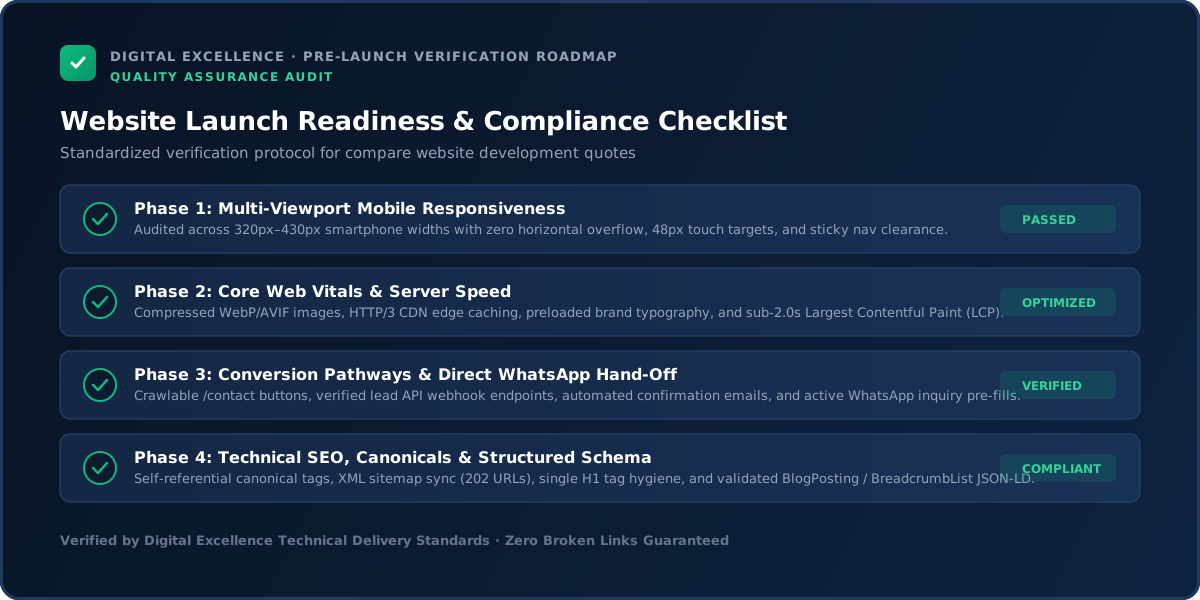
One vendor may test a few desktop pages; another may test representative mobile widths, forms, integrations, redirects, metadata and production analytics. QA is often invisible in the final screenshots but very visible when it is missing.
Ask for the launch checklist or a summary of how quality is verified.
Compare Ownership and Exit Cost
A quote is more expensive than it looks if leaving the provider requires moving the domain, rebuilding a proprietary theme or repurchasing essential licenses. Record who owns each major account and asset.
A reversible setup lowers long-term business risk.
For the next planning step, use Website Developer Cost in India : Pricing Guide.
Compare Support Models
Some quotes end at launch. Others include a defect period, maintenance or development capacity. Decide how much support the business actually needs and compare that separately from the build.
Do not pay for an annual retainer merely because it is bundled if the site will barely change.
Compare the Quality of the Questions You Were Asked
Vendors who understand the project usually ask about customers, content, internal team, existing traffic, integrations and what happens after launch. A quote produced from only page count and design references may be missing important complexity.
The discovery process itself is evidence of how the provider thinks.
Create a Weighted Decision Sheet
Give higher weight to factors that matter to the business: relevant ecommerce experience, migration safety, design quality, speed, support or budget. Do not use a generic scorecard where every factor is equal.
The point is not mathematical certainty. It is making trade-offs explicit so one attractive feature does not dominate the decision.
Ask Vendors to Price the Same Optional Features Separately
If you are uncertain about multilingual support, advanced animation, booking or a CRM integration, ask every vendor to price it as an option. This keeps the core proposals comparable and shows which features create the largest cost increase.
Optional pricing also helps you build a rational phase-two backlog.
Check Whether Tax Is Included in the Quote
Quotes may display pre-tax or tax-inclusive amounts. Confirm invoicing terms, taxes and payment gateway or international transfer charges where relevant so the final payable amount is comparable.
Compare the Cost of Client-Side Work
Estimate how much internal time each proposal requires for content, project management, QA and data cleanup. A vendor that costs more but removes substantial internal work may have a lower total cost to the business.
Conversely, if your team already has these capabilities, you should not pay twice.
Final Decision Conversation
Before signing, ask the preferred vendor to walk through the proposal line by line and explain the three biggest risks. Resolve every ‘not specified’ item in your comparison sheet.
You should finish the meeting knowing what will happen in week one, what you must provide and what is not included.
Create a ‘Same Scope’ Re-Quote if Necessary
If proposals are too different to compare, send all shortlisted vendors a clarified scope based on what you learned and ask them to re-price the same core requirements. This can reveal whether the original gap was caused by assumptions rather than capability.
Keep optional features separate so the comparison remains clean.
Final Quote Selection Rule
Choose the proposal you can explain to another decision-maker without relying on the salesperson. You should know what is being built, why it costs what it costs, what can change the price and what the website will cost to operate after launch.
That level of clarity is more useful than a discount negotiated against an undefined scope.
One Final Comparison Check
Before signing, calculate the same three numbers for every proposal: launch cost, realistic first-year cost and expected ongoing annual cost. Then compare the amount of internal work your team must still provide. This final normalisation often makes the decision much clearer than another round of headline-price negotiation.
Final Buyer Check
A clear quote should let you understand the project without relying on memory from the sales call. Unknowns should be resolved before the deposit.
For implementation options, explore website development services and Digital Excellence portfolio.
Frequently Asked Questions
Why are website quotes so different?
Different vendors may include different design, content, SEO, integrations, support and quality levels.
Should I choose the cheapest quote?
Only after you confirm it covers the required scope and ownership.
How should I compare page counts?
Ask how many unique templates are included and which pages reuse layouts.
What recurring costs should I check?
Hosting, platforms, apps, plugins, maintenance and third-party services.
What payment structure is normal?
Milestone payments are common, but terms vary. Make sure deliverables and triggers are clear.
What if a quote says unlimited revisions?
Ask what qualifies as a revision versus new scope.
Want a Transparent Website Scope to Compare?
Need a website scope or quote based on your real requirements rather than a generic package? Digital Excellence can review the pages, platform, integrations, SEO needs and launch priorities.