Gym & Fitness Website Development Cost in India

A gym and fitness website should make it easier for a prospective customer or member to evaluate the organisation and take the next step. The project may need memberships, class schedules, trainers, facility information, trial booking and optional payments or member systems. That means the cost is driven by workflow and content, not just the number of pages. This guide explains gym website development cost India through practical workstreams so buyers can compare quotes, avoid unnecessary custom development and budget for the systems that must remain reliable after launch.
Table of Contents
- What a Gym & Fitness Website Actually Needs
- Information Architecture and Content
- Mobile-First User Journey
- Trust and Proof
- Conversion Path
- Integrations and Operations
- SEO Opportunities
- Performance and Page Experience
- Analytics and Measurement
- Hidden and Recurring Costs
- How to Reduce Cost Without Weakening Quality
- What to Ask Before Hiring a Developer
- Final Takeaway
- Gym & Fitness: Scope Drivers That Change the Quote
- Content Production Is a Real Workstream
- Choose the Platform Around Editing and Operations
- Mobile Design Needs Category-Specific QA
- Trust Content Should Be Built, Not Decorated
- Integrations Can Cost More Than Extra Pages
- SEO Architecture Should Be Decided Before Publishing at Scale
- Performance Budget for the Real Production Stack
- Analytics Should Measure the Business Outcome
- Ownership, Handover and Ongoing Cost
- What to Prioritise When the Budget Is Limited
- Post-Launch Content Governance
- Final Budget Decision Framework
- Final Buyer-Side Scope Test
- Category-Specific Final Check
- Frequently Asked Questions
Gym & Fitness Website Planning Bands
| Level | Broad planning band | Typical scope |
|---|---|---|
| Focused site | ₹30,000–₹70,000 | core pages + primary conversion |
| Growth site | ₹70,000–₹1,80,000 | stronger UX, content, SEO, integrations |
| Advanced build | ₹1,80,000–₹4,00,000+ | membership systems, class booking, payment or member-portal integrations |
What a Gym & Fitness Website Actually Needs
Fitness visitors need to understand location, facilities, membership options, classes, trainers and how to try or join. The website should motivate without promising guaranteed physical transformations.
Information Architecture and Content
Create clear membership, class/training, trainer, facilities, location and trial pages. Use accurate schedules and avoid health/fitness outcome guarantees.
Create separate pages when the user need is meaningfully different. Avoid publishing near-duplicate pages just to target small keyword variations.
Mobile-First User Journey
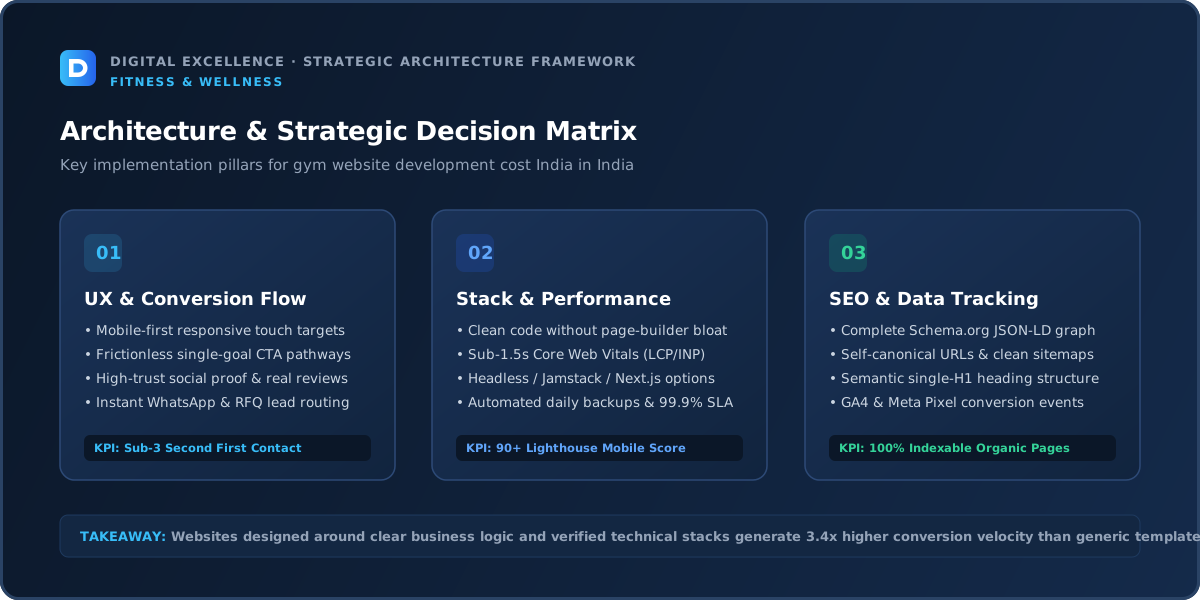
Potential members often search locally from phones. Trial booking, call, directions, timetable and membership information should be easy to reach.
Test the highest-value journey at common phone widths and real devices where practical. Responsive code alone does not guarantee a readable or usable mobile experience.
Trust and Proof
Use real facility/trainer imagery, genuine qualifications where applicable and realistic program descriptions. Avoid guaranteed weight loss or transformation claims.
Use only factual credentials, certifications, outcomes, staff information or awards that are genuinely verifiable. Trust-sensitive industries are harmed by inflated claims more than they are helped by decorative badges.
Conversion Path
Primary action may be Book a Trial, Visit Gym, Join or Call. Explain what a trial includes and what the member should bring or expect.
The CTA should describe the real next step and explain what happens after the action. This reduces uncertainty and improves lead quality.
Integrations and Operations
Class scheduling, membership management, payments, CRM and access-control or member portal systems can affect scope.
Identify these systems during discovery. Late integration requirements can change architecture, security, cost and testing.
SEO Opportunities
Service/class and genuine location pages can target real local demand. Fitness articles should stay within actual expertise and avoid mass health claims.
Use descriptive URLs, unique titles and meta descriptions, one H1, crawlable internal links and sitemap coverage. Google recommends useful people-first content. Avoid mass-producing thin location or service pages that add no unique value.
For a related buying decision, see Gym & Fitness Website Not Converting? What to Fix.
Performance and Page Experience
For “Gym & Fitness Website Development Cost in India”, apply performance and page experience to the exact scope and audience behind “gym website development cost India” so this guidance becomes a project decision rather than a generic website checklist.
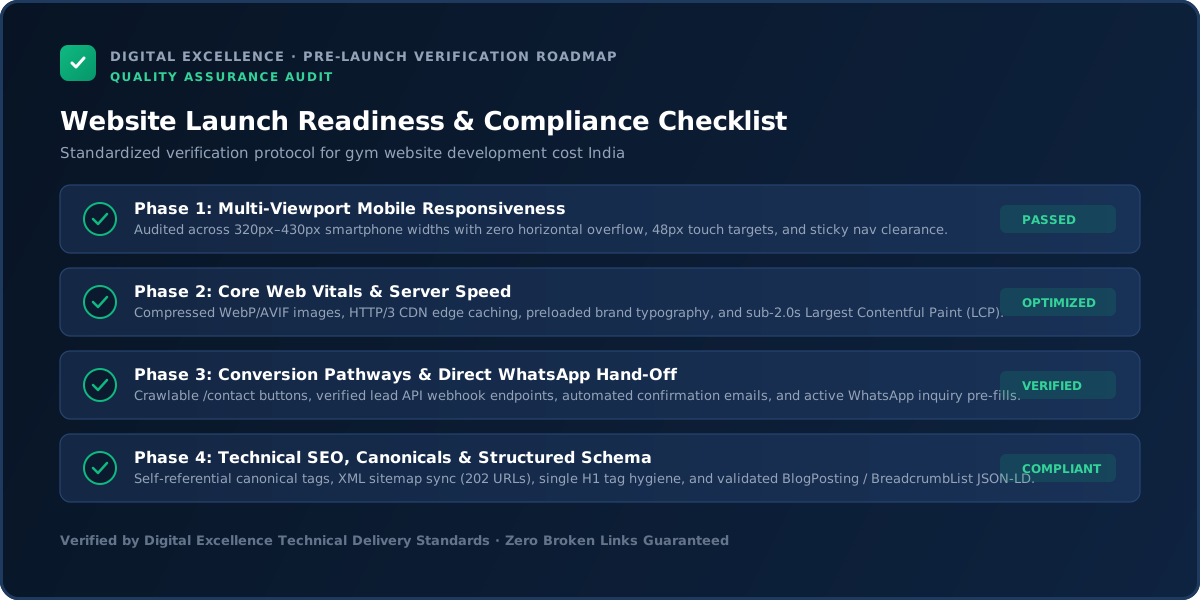
Optimise media, fonts, scripts and third-party widgets. Use Core Web Vitals as diagnostics for loading, interaction and visual stability, then test the real user journey on mobile.
Rich galleries, maps, calendars and embedded systems can be valuable, but they should not make the core action difficult to reach.
Analytics and Measurement
Track trial bookings, membership enquiries, calls, directions and completed joins where CRM data permits.
Measure the business action rather than only pageviews. Where possible, connect source and landing page with qualified outcomes.
How to Reduce Cost Without Weakening Quality
For “Gym & Fitness Website Development Cost in India”, apply how to reduce cost without weakening quality to the exact scope and audience behind “gym website development cost India” so this guidance becomes a project decision rather than a generic website checklist.
Prepare accurate content, assets and operational rules early. Use established platforms when they support the workflow cleanly. Launch with core functionality and move speculative features to phase two.
Do not remove mobile QA, ownership, security basics, backups, analytics or SEO hygiene simply to reduce the headline quote.
What to Ask Before Hiring a Developer
Ask for relevant live work, platform reasoning, content responsibilities, mobile QA, integration experience, SEO scope, ownership, support and recurring costs.
Ask specifically how they would handle class schedules, trial booking, membership systems and local mobile traffic. A good answer should connect technology to the actual user journey.
Final Takeaway
The best gym and fitness website budget pays for accurate information, a trustworthy mobile experience and an operational system the team can maintain. Choose complexity only where it solves a real customer or staff problem.
Gym & Fitness: Scope Drivers That Change the Quote
The website often creates the visit rather than the final membership sale, so offline follow-up and attendance are part of the conversion system. In practice, the price moves when the website must support location, facilities, class/training fit, membership guidance, trial experience and opening hours. A quote should therefore separate the customer-facing pages from the systems behind them.
Ask the developer to identify which work is template-based, which sections are uniquely designed, how much content/data is being loaded and which integrations require custom testing. This makes two proposals comparable even when both are described simply as a “gym & fitness website.”
For a useful scope comparison, read Small Business Website Cost in India.
Content Production Is a Real Workstream
For gym and fitness, strong implementation depends on accurate membership information, facilities, classes, trainers, timetable, location, FAQs and trial/visit booking. If the business already has final content, development can move faster. If the agency must research, structure, write, collect approvals or clean existing material, that work should be visible in the scope.
Use real content during design instead of perfect placeholder text. Long headings, incomplete data and category-specific detail change responsive layouts and often reveal problems before coding is finished.
Choose the Platform Around Editing and Operations
The best platform is the one the team can operate after launch while supporting trial booking, membership/CRM, payments, class scheduling, access/member systems and follow-up. A CMS or commerce platform can reduce cost when its native features match the workflow; custom development is justified when standard tools cannot support an important requirement cleanly.
Before approving a stack, ask who will update routine content, how preview/staging works, what third-party tools are required and what happens if the original developer is unavailable.
Mobile Design Needs Category-Specific QA
For Gym & Fitness, mobile QA should cover trial booking, class timetable, call, directions and membership pages. Test the highest-value task on real phones, not only responsive screenshots. Check keyboard behaviour, sticky elements, third-party widgets, long pages and slow connections.
A design can technically “fit” on mobile while still making the core decision exhausting. Budget for mobile states and QA as first-class work rather than a final compression of the desktop layout.
Trust Content Should Be Built, Not Decorated
The trust system for this category is real facility imagery, genuine trainer credentials where applicable, realistic programme descriptions and transparent membership information. These elements need content, placement and maintenance; they are not interchangeable badges.
A lower-cost build that omits the proof buyers need may generate more sales friction later. At the same time, do not buy decorative review widgets or authority claims the business cannot substantiate. Strong trust design makes verification easier.
Integrations Can Cost More Than Extra Pages
trial booking, membership/CRM, payments, class scheduling, access/member systems and follow-up can affect architecture, authentication, privacy, data flow, error handling and testing. A simple five-page website with a difficult integration can require more engineering than a 30-page content site.
List the external systems before requesting the final quote. For each one, clarify who owns the account, whether an API is available, what happens if the service is down and whether recurring software fees sit outside the development price.
SEO Architecture Should Be Decided Before Publishing at Scale
A useful SEO structure for Gym & Fitness can cover gym, class, training, membership and genuine local intent. Map one primary intent to each important URL and use supporting articles for genuinely different questions.
Avoid publishing dozens of near-identical pages simply because keyword wording changes. The better investment is a smaller set of pages with specific information, crawlable internal links, self-canonicals, clear headings and a sitemap that reflects the preferred indexable URLs.
For the next planning step, use Landing Page Cost in India: 2026 Guide.
Performance Budget for the Real Production Stack
For “Gym & Fitness Website Development Cost in India”, apply performance budget for the real production stack to the exact scope and audience behind “gym website development cost India” so this guidance becomes a project decision rather than a generic website checklist.
Media, fonts, chat, reviews, maps, calendars and marketing tags can all change performance after the clean design preview. Define a practical performance budget for important templates and test with the production integrations loaded.
Use Core Web Vitals as diagnostic signals, but also complete the real mobile journey. The business outcome matters more than an isolated synthetic score that was achieved by disabling functionality users actually need.
Analytics Should Measure the Business Outcome
For gym and fitness, useful measurement includes trial bookings, membership enquiries, visits, calls and joined members where CRM can connect them. Track the primary outcome and a small number of diagnostic steps that help explain why users drop.
Where possible, pass service/product/context into the CRM or order system so the team can judge lead or customer quality by landing page and source. A website that reports only sessions and clicks is difficult to optimise commercially.
Ownership, Handover and Ongoing Cost
For “Gym & Fitness Website Development Cost in India”, apply ownership, handover and ongoing cost to the exact scope and audience behind “gym website development cost India” so this guidance becomes a project decision rather than a generic website checklist.
Before final payment, the business should understand domain, hosting/platform, repository or theme access, analytics, Search Console, premium tools and the maintenance process. Document what is owned directly by the client and what depends on a vendor licence.
Calculate year-one cost and a normal following year separately. Hosting, apps, CRM, booking, email, subscriptions and maintenance can materially change total cost even when the initial development quote looks attractive.
What to Prioritise When the Budget Is Limited
Protect the parts that reduce the biggest buyer risk: clear information, mobile usability, reliable action flow, analytics, technical SEO basics and ownership. Simplify animation, optional integrations or low-priority pages before removing those foundations.
For Gym & Fitness, a focused launch that answers location, facilities, class/training fit, membership guidance, trial experience and opening hours is usually more useful than a larger website filled with thin pages. Keep phase-two ideas in a backlog and let real search, customer and sales data decide which additions deserve budget.
Post-Launch Content Governance
The website remains useful only if membership information, facilities, classes, trainers, timetable, location, FAQs and trial/visit booking stays current. Assign a content owner, record which information changes frequently and schedule review around launches, seasons or regulatory/business changes that genuinely affect the page.
This is especially important for a category where general fitness content generating traffic while the local membership journey remains unclear. Stale information can create poor leads, support load and trust problems even when the original development was technically strong.
Final Budget Decision Framework
When comparing proposals, normalise scope across design, content, development, integrations, SEO foundations, analytics, QA, handover and support. Then ask which provider has correctly understood the risks of gym and fitness, not simply which one lists the most features.
A strong proposal should let another competent professional understand what will be built, how it will be tested and what the business will need to operate it after launch.
Final Buyer-Side Scope Test
Before final sign-off, run a category-specific buyer review for Gym & Fitness. Give a fresh mobile session to someone who resembles the target customer and ask them to evaluate facilities, trainer/class options, trial experience, membership expectations and local convenience. Record every question they still need to ask a salesperson, receptionist, admissions team or support agent.
Then compare those questions with the proposed scope. If the same uncertainty will create repeated manual conversations, it is usually cheaper to solve it with structured content, a reusable component or a clearer workflow before launch. This final review also helps decide whether optional features are actually valuable or merely decorative.
Category-Specific Final Check
For a gym website budget, include the workflow after a trial request. The site may need to route prospects to a membership team, send reminders and preserve the selected location or class interest. That operational layer can matter more to revenue than adding another marketing page, especially when the sale is completed during an in-person visit.
For implementation options, explore website development services and Digital Excellence portfolio.
Frequently Asked Questions
How much does a gym and fitness website cost in India?
A focused site may cost from the tens of thousands of rupees, while advanced integrations, large content/data requirements or portals can move into several lakhs.
Which platform should I use?
Choose based on content, integrations, operational needs, security and maintainability. There is no universal best platform.
How long does development take?
A focused site can take a few weeks; larger data, content, approvals or integrations can take significantly longer.
Does development include SEO?
Clarify the scope. Technical/on-page foundations may be included; ongoing SEO, content and authority work are separate.
Do I need custom development?
Only when standard CMS, booking or ecommerce tools cannot support the required workflow cleanly.
What should I prepare before development?
Accurate content, brand assets, operational rules, integrations, data and account access needed for implementation.
Planning a Gym & Fitness Website?
Need a website scope or quote based on your real requirements rather than a generic package? Digital Excellence can review the pages, platform, integrations, SEO needs and launch priorities.