Landing Page Developer in Delhi: Google Ads Conversion Guide

If you searched for “Landing Page Developer in Delhi”, start with the business problem you want to fix rather than the redesign itself. Measure the current journey, protect what already works and change the highest-value source of friction first. This guide explains how to plan the work without turning every problem into a full rebuild.
Table of Contents
- Diagnose Before You Rebuild
- Set a Baseline
- Failure Scenarios to Plan For
- Fix the Highest-Risk Friction First
- Protect Existing SEO Signals
- Mobile and Performance QA
- Measurement After Launch
- When a Full Rebuild Is Justified
- Rollout and Risk Control
- What to Prepare Before Development
- Launch Checklist
- The First 30 Days After Launch
- What to Keep for Phase Two
- Decision Summary
- Local Delivery and Relevance for Delhi
- Implementation Questions to Resolve Before Sign-Off
- How Digital Excellence Can Structure the Project
- Related Guides to Read Before You Hire
- Frequently Asked Questions
- Frequently Asked Questions
| Area | What to verify | Buyer question |
|---|---|---|
| Scope | discovery and requirements, sitemap and content structure, responsive UI | What exactly is included? |
| Risk | vague deliverables, unclear account ownership | How is this prevented? |
| Proof for landing page development | relevant live work | What did the provider actually deliver? |
| Ownership | domain, CMS, analytics, third-party accounts | What do we control? |
| Measurement | qualified enquiries, form completion, phone or WhatsApp clicks | How will success be measured? |
Diagnose Before You Rebuild
For this landing-page project in Delhi, begin with evidence. In the launch plan, review ad-to-page message match, above-the-fold clarity, form friction, trust, and tracking quality. For the client team, do not assume a full redesign is necessary until you know where users drop, what breaks and which pages already generate useful traffic or conversions.
Set a Baseline
In the launch plan, record the current pages, traffic sources, device split, conversion events, Core Web Vitals and any commercial metric that matters. For the client team, without a baseline, a new design can feel better while the business loses search visibility, attribution or lead quality.
Failure Scenarios to Plan For
One of the easiest mistakes in this landing-page project is fixing the most visible symptom instead of the first meaningful leak in the journey. For this landing page project, use page, source and device data to identify where users stop, then test the smallest change that can address that cause. On this landing page project, fixing one visible symptom can add risk if the real problem is a third-party tool, slow asset or unclear offer.
Fix the Highest-Risk Friction First
Within the Delhi project brief, prioritise failures that block the primary action: form friction, broken forms, payment or booking errors, unreadable mobile layouts and slow critical content. For this landing page development use case, cosmetic polish should come after the journey works reliably.
Protect Existing SEO Signals
For this landing page development use case, preserve useful URLs when possible. In the delivery plan, if a URL must change, map it to the most relevant replacement, update internal links, keep important content accessible and verify canonical tags, sitemap output and indexability. For the live site, do not launch a redesign with blanket redirects to the homepage.
Mobile and Performance QA
In the delivery plan, test the key journey on real mobile widths and slower networks. For Delhi traffic, the location itself does not change the technical standard: controls must be tappable, content must remain stable, and heavy media should be delivered responsively. In the final scope, measure performance on representative templates rather than one empty demo page.
Measurement After Launch
For the live site, compare the new experience against the baseline using the same definitions and segments. In the final scope, watch qualified conversions, search impressions, error reports and support feedback. For this Delhi landing page development project, low-traffic sites may need qualitative evidence from sales calls and customer questions because short-term percentages can be noisy.
When a Full Rebuild Is Justified
In the final scope, a rebuild makes sense when the CMS, information architecture, design system or technical foundation causes repeated problems that cannot be fixed cleanly. For this Delhi landing page development project, if one landing page, form or checkout step is the main issue, a targeted improvement is usually safer and faster.
Rollout and Risk Control
For this Delhi landing page development project, use staging, device testing and a written launch checklist. In the landing page development scope, for higher-risk migrations, consider phased releases, monitoring and a rollback plan. For the buyer journey on this Delhi project, the objective is not to avoid every change; it is to make failures detectable and recoverable.
What to Prepare Before Development
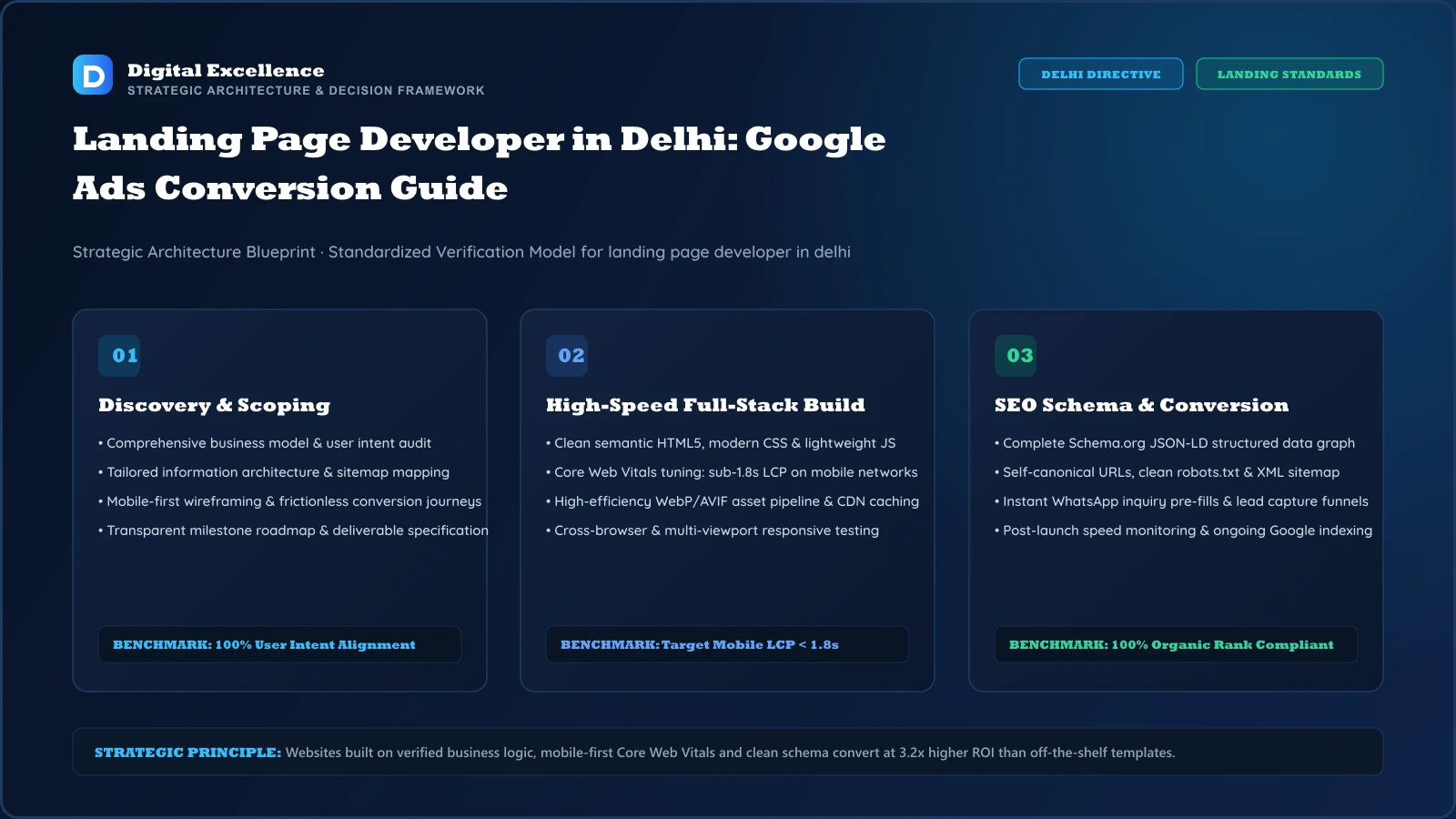
Before kickoff on this landing-page project, prepare the business goal, priority audience, current website access, brand assets, content owner, required integrations and examples of the journeys that matter. For landing page development, also document the three items most likely to change the scope: discovery and requirements, sitemap and content structure, responsive UI. For this requirement, a prepared brief shortens discovery and makes it easier to separate mandatory work from ideas that can wait.
Launch Checklist
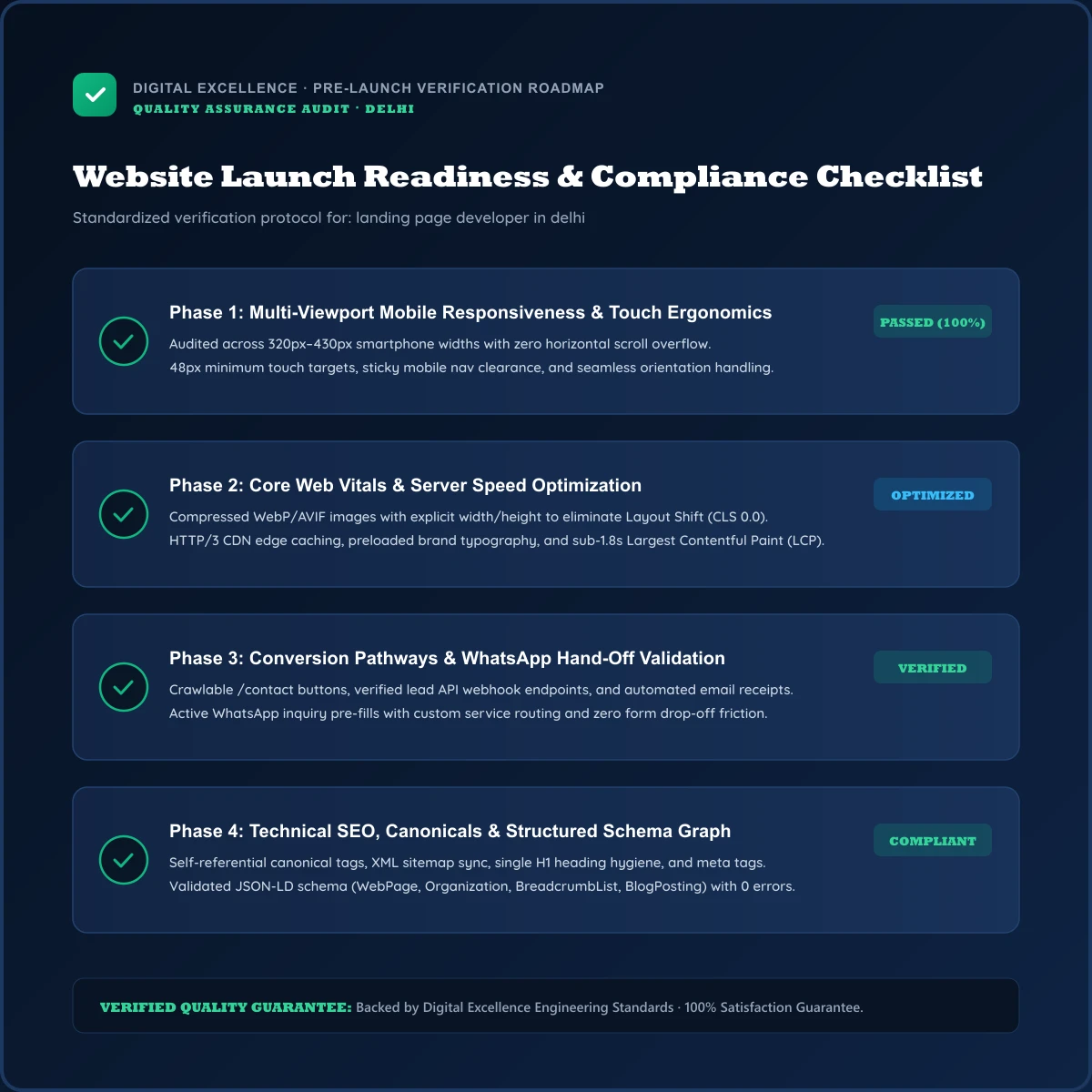
A launch checklist for this landing-page project should cover the primary conversion path, mobile layouts, forms or checkout, analytics events, titles and metadata, canonical tags, sitemap output, internal links, image dimensions, error states and account access. On this page, the Delhi keyword does not change the QA standard; the site still needs to work for any user who reaches it. In the launch plan, record the launch date and major changes so later performance reviews can separate real improvement from seasonality or campaign changes.
The First 30 Days After Launch
During the first 30 days after publishing this landing page, watch crawl/index coverage, real enquiries or transactions, device-specific problems, form or payment failures and search impressions. In the launch plan, review the quality of leads, not only their count. For the client team, if the page attracts the wrong audience, adjust the offer, content and internal links before adding more location or keyword pages. Within the Delhi project brief, where traffic is still small, combine analytics with questions heard on sales calls and support conversations.
What to Keep for Phase Two
Phase two should be driven by evidence from the live landing page development project. For the client team, once the initial site is stable, review search queries, qualified conversions, sales feedback, support issues and the metrics that matter—qualified enquiries, form completion, phone or WhatsApp clicks. Within the Delhi project brief, only then decide whether new landing pages, automation, integrations or a deeper redesign deserve more budget.
Decision Summary
The final decision on this landing-page project should be based on fit: can the proposed scope support the business outcome, can the team prove the relevant capability, and will the client retain control of critical accounts and content? Within the Delhi project brief, if those answers are clear, the technical stack becomes a practical implementation choice rather than the centre of the buying decision.
Local Delivery and Relevance for Delhi
For a Delhi or Delhi NCR buyer evaluating this landing-page project, the page should explain the landing page development scope and delivery model before it tries to look “local.” Merge company/developer/agency/top/best wording into the strongest Delhi page when the intent is the same. For this landing-page topic, create a separate NCR or locality page only when the business has distinct proof, branch information, service coverage or lead-routing details.
Implementation Questions to Resolve Before Sign-Off
Before the landing page development project is approved for launch, resolve the implementation details that are easy to miss in design reviews. For the buyer journey on this Delhi project, confirm who owns content updates, who receives enquiries, which account stores analytics data, how discovery and requirements and sitemap and content structure will be tested, and what the support path is after launch. During this landing page development implementation, list the third-party services that can break the journey and identify a fallback or escalation path for each one. For this requirement, also document what the client can edit safely, what requires developer help and which changes could affect SEO or integrations. In the launch plan, this short operational checklist prevents a polished handover from turning into uncertainty a week later.
How Digital Excellence Can Structure the Project
For this landing-page project in Delhi, Digital Excellence can begin with the business goal, translate it into discovery and requirements, sitemap and content structure and a responsive build, then add technical SEO foundations, analytics and launch QA. Relevant portfolio and testimonials should be pulled from real tagged projects rather than inserted as generic proof. Use one central offer component on the live site so package terms can change once without leaving stale promises across dozens of pages.
Related Guides to Read Before You Hire
Before signing the project, the most useful supporting reads are Website Development Cost in India, How to Choose a Website Development Company in India and How Long Does Website Development Take?. Place those links inside the sections where the reader is making that decision—for example beside pricing, platform choice or proposal comparison—rather than grouping them as a keyword-heavy footer.
Frequently Asked Questions
These are the practical questions buyers commonly ask before proceeding with a landing-page project.
The Digital Excellence Complete Website Package
Everything your business needs to launch a high-performing digital presence with zero technical headaches.
Frequently Asked Questions
How long should a website project take?
In the final scope, it depends on scope, content readiness, integrations and approval speed. For this Delhi landing page development project, tie the schedule to milestones and dependencies instead of a universal number.
Should SEO be included during development?
For this Delhi landing page development project, technical foundations such as crawlability, titles, headings, internal links, canonicals, sitemap and performance should be part of the build.
Who should own the website accounts?
In the landing page development scope, the business should have appropriate access to the domain, hosting, CMS, analytics, Search Console and critical third-party services.
What should be tested before launch?
For the buyer journey on this Delhi project, test mobile layouts, forms, checkout or booking actions, links, analytics, metadata, redirects where relevant and important error states.
Discuss Your Website Requirement
Planning a landing-page project in Delhi? Share the current website, business goal, required functionality and preferred timeline. Digital Excellence can review the requirement and discuss an appropriate landing page development scope before development begins.
PRIMARY CTA: Book a Free Consultation → /contact
SECONDARY: View Portfolio → /#portfolio
SECONDARY: Website Services → /#services