Logistics Company Website Developer in Delhi NCR: B2B Enquiry Guide

If you searched for “Logistics Company Website Developer in Delhi NCR”, the website needs to match the industry’s real buyer journey. The pages, proof, integrations and conversion path should reflect how customers actually choose or buy in this category. This guide turns those requirements into a practical scope for a Delhi project.
Table of Contents
- Design Around the Real Buyer Journey
- Pages the Website Should Prioritise
- Features That Matter for This Business Model
- Trust and Proof
- The Most Common Failure Pattern
- Mobile Experience
- SEO Architecture
- Integrations and Operations
- Conversion and Lead Quality
- How to Evaluate a Developer
- What to Prepare Before Development
- Launch Checklist
- The First 30 Days After Launch
- What to Keep for Phase Two
- Decision Summary
- Local Delivery and Relevance for Delhi
- Implementation Questions to Resolve Before Sign-Off
- How Digital Excellence Can Structure the Project
- Related Guides to Read Before You Hire
- Frequently Asked Questions
- Frequently Asked Questions
| Decision area | What to verify | Why it matters |
|---|---|---|
| Buyer journey | generate qualified quote requests | ties the website to a commercial action |
| Core features | service coverage, shipment types, industries served | prevents a generic brochure build |
| Trust | real service/network evidence | reduces uncertainty |
| Main risk | unclear coverage | should be tested before launch |
Design Around the Real Buyer Journey
The audience is businesses needing transport or logistics, and the website should help them generate qualified quote requests. For the live site, that should determine navigation, proof and the main conversion path. For this logistics website project in Delhi, start with the questions a buyer asks before acting and place the strongest answers in the natural decision sequence.
Pages the Website Should Prioritise
For the live site, a useful site usually needs focused pages for the main service or product categories, proof, process, contact or booking, and supporting information that reduces uncertainty. Do not create extra pages simply to target every keyword variation; each URL should solve a distinct buyer task for businesses needing transport or logistics.
Features That Matter for This Business Model
In the final scope, prioritise service coverage, shipment types, industries served, quote form and tracking/integration if applicable. For this Delhi logistics project, these requirements should be mapped to real operations before design begins. In the logistics scope, if a feature relies on a CRM, booking tool, inventory system or payment provider, define the integration and failure behaviour in the scope.
Trust and Proof
For this Delhi logistics project, for this category, credible proof comes from real service/network evidence. In the logistics scope, do not fill gaps with invented client logos, fabricated revenue numbers or generic testimonials. For the buyer journey on this Delhi project, where the industry is regulated or claims can materially affect a buyer, keep language factual and conservative.
The Most Common Failure Pattern
In the logistics scope, a major risk is unclear coverage. For the buyer journey on this Delhi project, test the complete mobile journey with realistic content and data before launch. During this logistics implementation, if the issue is operational—inventory, schedules, delivery, availability or lead routing—fix the underlying workflow rather than decorating the website around it.
Mobile Experience
For the buyer journey on this Delhi project, many visitors will evaluate the business from a phone, so make service coverage and the main conversion action easy to use without zooming or hunting. During this logistics implementation, compress media, avoid unstable layouts and make error messages clear. For this requirement, mobile QA should include the pages with the heaviest media or most complex forms.
SEO Architecture
During this logistics implementation, build search visibility around the real service, category, product or problem hierarchy. For this requirement, use specific page titles, descriptive headings and internal links between commercial pages and useful supporting guides. In the launch plan, do not create thin city or tag pages where the only meaningful difference is the keyword.
Integrations and Operations
For this requirement, list any CRM, payment, booking, inventory, email, analytics or support systems required for generate qualified quote requests. In the launch plan, for each integration, state who owns the account, what data moves, what happens when the service is unavailable and how the integration is tested.
Conversion and Lead Quality
In the launch plan, the best conversion is the one that matches the business model. For businesses needing transport or logistics, that may be a purchase, reservation, consultation, RFQ, application or tour booking. Within the Delhi project brief, use forms that collect enough information to qualify the next step without asking for unnecessary data.
How to Evaluate a Developer
When hiring for this logistics website project, ask for relevant work, a written feature scope and an explanation of how the team will handle service coverage and unclear coverage. Within the Delhi project brief, the provider should be able to explain the workflow beyond the visual design.
What to Prepare Before Development
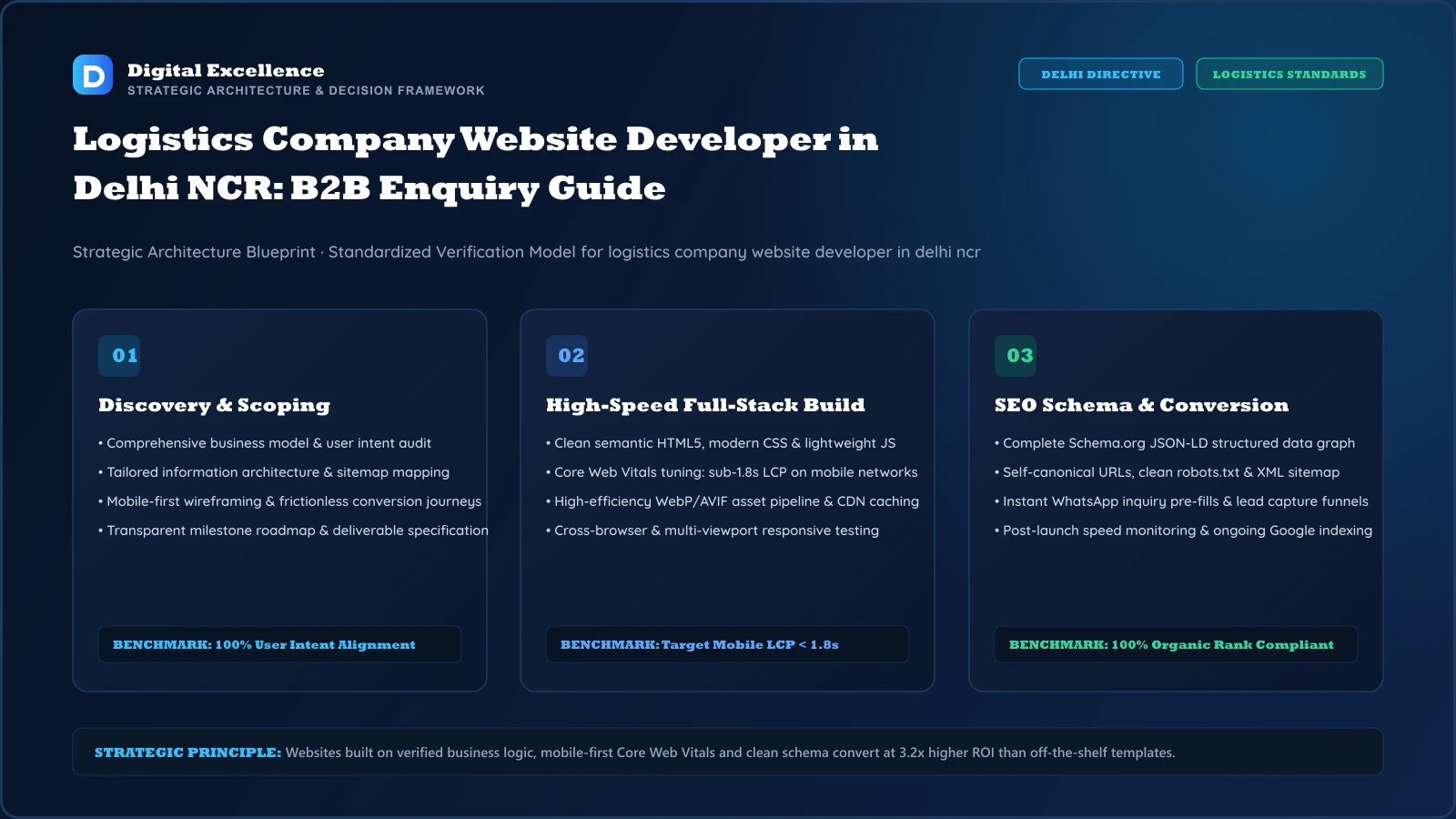
Before design begins on this logistics website project, collect the real content that affects generate qualified quote requests: service or product information, policies, contact or booking rules, imagery, proof and any integration credentials. In the delivery plan, map who owns service coverage and shipment types, because missing operational details usually create more delay than visual design. For the live site, also identify which claims need verification and which data changes frequently so the CMS or admin workflow can support updates without developer dependency.
Launch Checklist
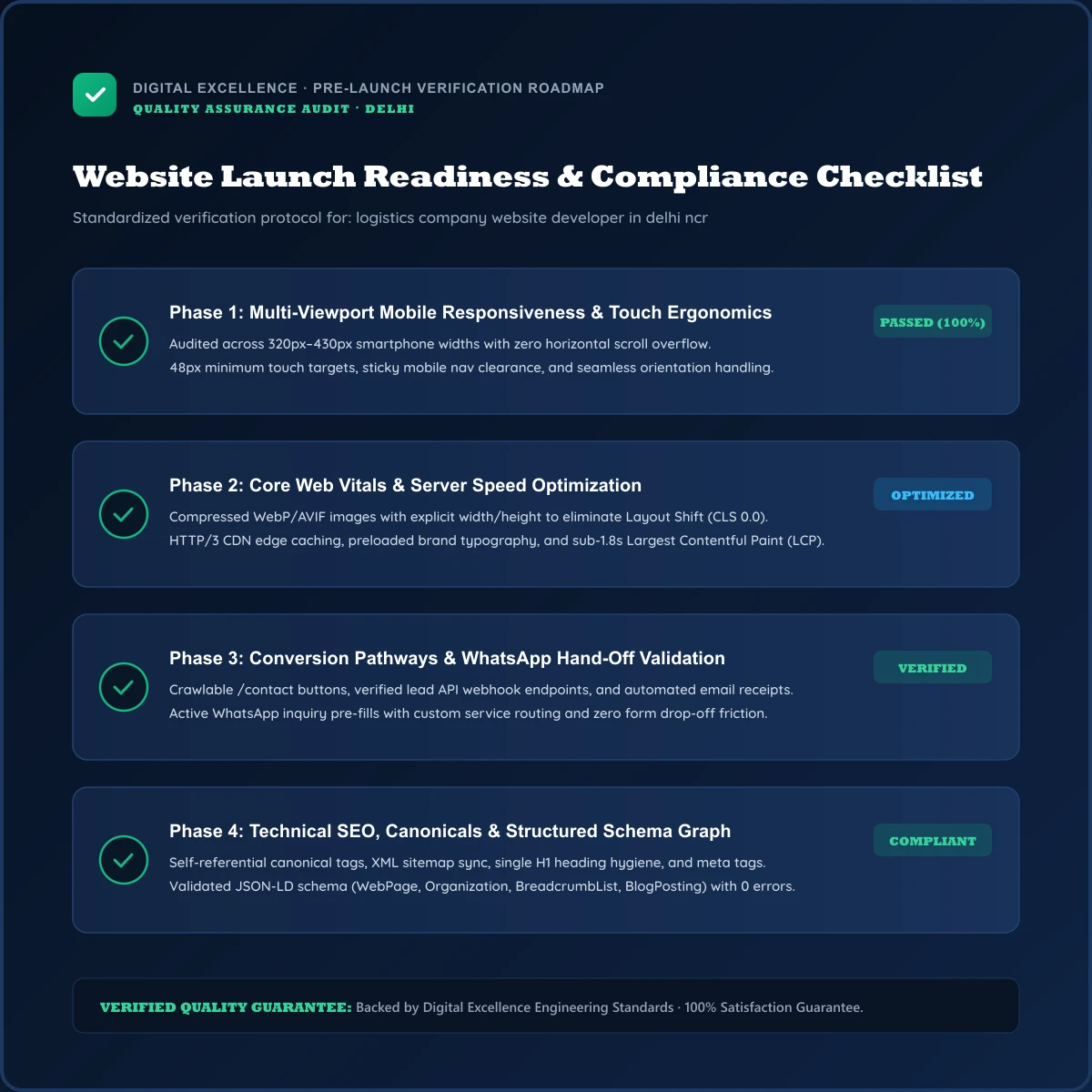
A launch checklist for this logistics website project should cover the primary conversion path, mobile layouts, forms or checkout, analytics events, titles and metadata, canonical tags, sitemap output, internal links, image dimensions, error states and account access. On this page, the Delhi keyword does not change the QA standard; the site still needs to work for any user who reaches it. In the final scope, record the launch date and major changes so later performance reviews can separate real improvement from seasonality or campaign changes.
The First 30 Days After Launch
During the first 30 days after publishing this logistics website page, watch crawl/index coverage, real enquiries or transactions, device-specific problems, form or payment failures and search impressions. In the final scope, review the quality of leads, not only their count. For this Delhi logistics project, if the page attracts the wrong audience, adjust the offer, content and internal links before adding more location or keyword pages. In the logistics scope, where traffic is still small, combine analytics with questions heard on sales calls and support conversations.
What to Keep for Phase Two
In the final scope, do not force every desirable feature into the first release. For this logistics project, launch the pages and workflows needed for generate qualified quote requests, then use real enquiries or transactions to decide whether advanced automation, extra content hubs or deeper personalisation deserves phase two. In the logistics scope, this keeps the first build focused and gives later work evidence to respond to rather than assumptions.
Decision Summary
The final decision on this logistics website project should be based on fit: can the proposed scope support the business outcome, can the team prove the relevant capability, and will the client retain control of critical accounts and content? In the logistics scope, if those answers are clear, the technical stack becomes a practical implementation choice rather than the centre of the buying decision.
Local Delivery and Relevance for Delhi
For this logistics website project in Delhi in Delhi NCR, decide whether Delhi, Noida, Gurugram and other NCR locations genuinely change the service, proof or lead-routing workflow. For this business model, the stronger local detail is how service coverage and the route to generate qualified quote requests are handled, not a set of cloned city paragraphs. Use separate location pages only when there is real branch, team, logistics or service-area information to support them.
Implementation Questions to Resolve Before Sign-Off
Before sign-off on this logistics website project, resolve the operational questions behind the design. Within the Delhi project brief, decide who maintains service coverage, who approves changes to shipment types, where enquiries or transactions are routed, and what happens when an integration fails. For this logistics use case, confirm the source of real service/network evidence, because proof cannot be added later as an invented placeholder. Document the mobile journey for businesses needing transport or logistics, including the first page they land on, the information they need before acting and the final step used to generate qualified quote requests. For the live site, finally, agree which changes the internal team can make without a developer and which changes require technical support. In the final scope, that operational detail is what turns a visually complete website into a site the business can actually run.
How Digital Excellence Can Structure the Project
Digital Excellence can structure this logistics website project around the actions that matter for businesses needing transport or logistics: build the page hierarchy, design the mobile journey, connect the required forms or commerce workflow, and set up technical SEO and analytics before launch. The live page should show real portfolio work relevant to service coverage or shipment types when that proof exists. Render the current agency offer from one central site component so maintenance, SEO duration, hosting/domain terms, revisions and guarantee language stay consistent across the site.
Related Guides to Read Before You Hire
Before signing the project, the most useful supporting reads are Website Development Cost in India, How to Choose a Website Development Company in India and How Long Does Website Development Take?. Place those links inside the sections where the reader is making that decision—for example beside pricing, platform choice or proposal comparison—rather than grouping them as a keyword-heavy footer.
Frequently Asked Questions
These are the practical questions buyers commonly ask before proceeding with a logistics website project.
The Digital Excellence Complete Website Package
Everything your business needs to launch a high-performing digital presence with zero technical headaches.
Frequently Asked Questions
What should a logistics website prioritise?
In the launch plan, it should prioritise service coverage, shipment types and a clear route to generate qualified quote requests.
How should proof be shown?
For the client team, use real service/network evidence. Within the Delhi project brief, keep claims verifiable and avoid invented results.
Which metric matters most?
Within the Delhi project brief, measure the commercial action tied to the business model—purchase, booking, consultation, RFQ, application or another qualified outcome.
Do I need a custom website?
For this logistics use case, only when standard platforms cannot handle the workflow cleanly. In the delivery plan, choose the simplest stack that meets the operational requirement.
Discuss Your Website Requirement
Planning a logistics website project in Delhi? Share the current website, business goal, required functionality and preferred timeline. Digital Excellence can review the requirement and discuss an appropriate logistics scope before development begins.
PRIMARY CTA: Book a Free Consultation → /contact
SECONDARY: View Portfolio → /#portfolio
SECONDARY: Website Services → /#services