Why Is My Website Not Ranking on Google?

When a website does not rank, publishing more content is not always the answer. The site may not be indexed correctly, the target query may not match the page, competitors may provide much stronger answers or the domain may lack authority for a competitive term. SEO diagnosis should move from eligibility and indexing to relevance, quality and competition. This guide follows that order so you do not spend months fixing the wrong layer.
Table of Contents
- Step 1: Confirm the Page Can Be Indexed
- Step 2: Check Search Intent
- Step 3: Compare Content Quality Honestly
- Mobile Experience
- Technical Reliability and Core Web Vitals
- Search Intent and Content Match
- Trust and Proof
- CTA and Journey Friction
- Analytics and Measurement
- SEO and Internal Links
- Why More Blogs Can Make SEO Worse
- Fix Order
- 48-Hour Triage
- 30-Day Improvement Plan
- When a Redesign Is the Right Answer
- Final Takeaway
- Indexing and Ranking Are Different Problems
- Search Intent Can Change Over Time
- Cannibalisation Is Often an Architecture Problem
- Internal Links Should Connect Topic Clusters
- Titles and Snippets Affect Click-Through, Not Only Rankings
- Authority Can Be Topic-Specific
- Freshness Matters Only Where the Topic Changes
- Use Search Console as the Primary Feedback Loop
- Do Not Confuse Word Count With Quality
- Final Ranking Rule
- Check Canonical Consistency
- Robots Rules Can Accidentally Block Important Assets or Pages
- JavaScript Rendering Can Affect Discoverability
- Backlinks Cannot Rescue a Poor Search Match
- Branded Search Requires Entity Consistency
- Audit Duplicate Titles and Metadata at Scale
- Structured Data Should Match Visible Content
- Sitemaps Should Contain Preferred Indexable URLs
- Fix Broken Internal Links and Redirect Chains
- Final Technical SEO Rule
- Use Content Pruning Carefully
- Audit Orphan Pages
- Avoid Faceted Navigation Index Bloat
- Final SEO Diagnosis Principle
- Map Every Priority Keyword to One Preferred Page
- Final Principle
- Final Ranking Check
- Closing SEO Note
- Frequently Asked Questions
Diagnostic Checklist
| Layer | Question |
|---|---|
| Indexing | can Google crawl/index the page? |
| Intent | does the page answer the query? |
| Quality | is it substantial and useful? |
| Structure | are title/H1/URL/internal links clear? |
| Competition | what do ranking pages do better? |
| Authority | does the site have credible signals/links? |
| Experience | is the page usable and mobile-friendly? |
Step 1: Confirm the Page Can Be Indexed
Check Search Console URL Inspection, robots directives, noindex tags, canonicals and sitemap coverage. A page cannot rank if search engines are told not to index it or if a canonical points elsewhere.
Do not assume sitemap submission forces ranking. Sitemaps help discovery; they do not guarantee indexing or visibility.
Step 2: Check Search Intent
A service page may not rank for a query where Google predominantly shows educational guides, and a blog may struggle for a query where users clearly want a local company or product.
Search the target phrase and study the page types and questions represented. Build the page to satisfy the user need, not just to contain the keyword.
Step 3: Compare Content Quality Honestly
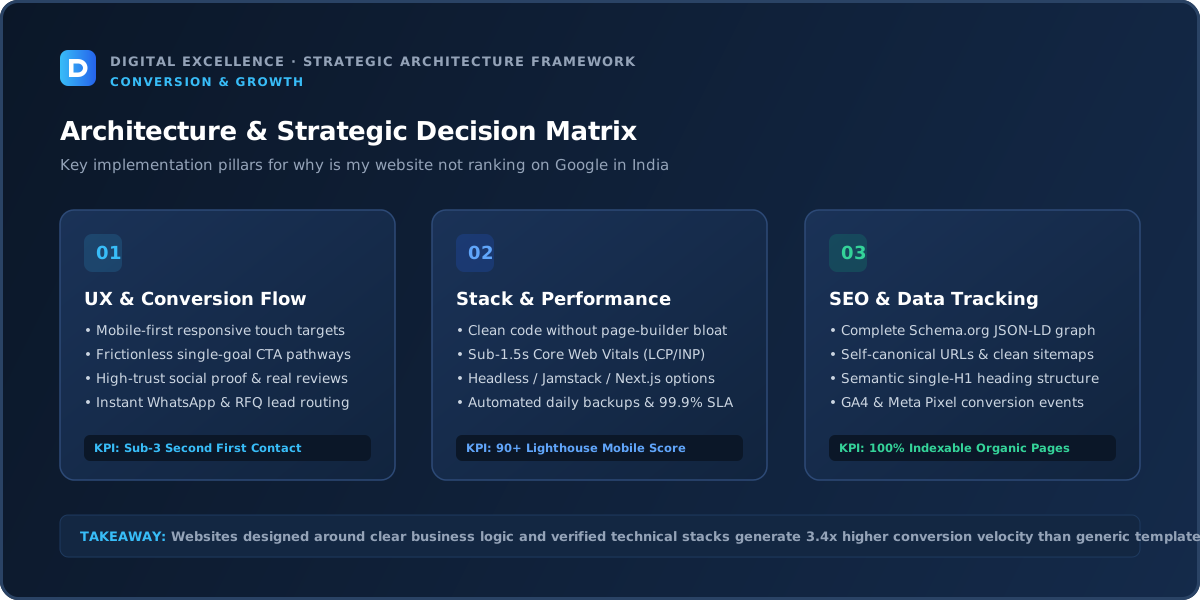
Google's people-first guidance asks whether content provides original information, substantial coverage and real value. Thin summaries and near-duplicate AI articles are unlikely to create a durable advantage.
Add first-hand examples, specific processes, useful comparisons and answers that reduce the reader's uncertainty. Remove fluff that exists only to reach a word count.
Mobile Experience
A practical way to use mobile experience here is to ask whether it changes qualified conversion for “why is my website not ranking on Google”. If the answer cannot be measured or observed, keep it behind higher-confidence fixes.
Review the issue on real mobile widths and devices, not only a desktop emulator. Check content hierarchy, typography, navigation, forms, buttons, media and any sticky or popup elements. Mobile problems can amplify small weaknesses because screen space and network conditions are constrained.
Compare mobile and desktop by the same traffic source when possible. A device gap can be caused by UX, but it can also be caused by different acquisition channels.
Technical Reliability and Core Web Vitals
A practical way to use technical reliability and core web vitals here is to ask whether it changes qualified conversion for “why is my website not ranking on Google”. If the answer cannot be measured or observed, keep it behind higher-confidence fixes.
Google's Core Web Vitals measure loading performance, interaction responsiveness and visual stability. Use them as diagnostic signals alongside real-user behaviour. Large images, scripts, plugins, apps, fonts and unstable components are common sources of friction.
Also test the actual business action. A fast site with a broken form, product selector or checkout still fails the user.
Search Intent and Content Match
Map one primary intent to each important page and prevent multiple pages from competing for the same query without a reason. Supporting articles should link naturally to the relevant commercial page.
Trust and Proof
Author identity, real company information, case studies, accurate claims and earned mentions can help the site feel more credible. Do not fabricate experience signals.
CTA and Journey Friction
Conversion elements should not overwhelm the main content. Intrusive overlays or ads can reduce page experience and distract from the answer the searcher came for.
Analytics and Measurement
Use Search Console impressions, average positions, queries and landing pages. A page with impressions but few clicks may have a title/relevance issue; a page with no impressions may have indexing, intent or authority problems.
SEO and Internal Links
A practical way to use seo and internal links here is to ask whether it changes qualified conversion for “why is my website not ranking on Google”. If the answer cannot be measured or observed, keep it behind higher-confidence fixes.
Review which queries and pages generate the traffic. Total sessions are not enough. A page can rank for broad informational terms that never had strong commercial intent.
Use contextual internal links to connect useful guides with relevant service, category or product pages. Google recommends crawlable links with meaningful anchor text. Do not create repetitive doorway pages simply to capture every variation of a phrase.
For a related diagnosis, see Website SEO Cost in India : What Happens After Development?.
Why More Blogs Can Make SEO Worse
Publishing large numbers of overlapping articles can dilute internal links, create cannibalisation and add pages that provide little new value. Google explicitly emphasises helpful, people-first content rather than content created primarily to manipulate rankings.
Build topic clusters deliberately. Consolidate weak overlapping pages when one comprehensive page would serve users better.
Fix Order
A practical way to use fix order here is to ask whether it changes qualified conversion for “why is my website not ranking on Google”. If the answer cannot be measured or observed, keep it behind higher-confidence fixes.
Fix broken functionality first, then traffic mismatch, unclear message, missing proof, mobile friction, conversion friction and performance polish. This prevents teams from running small experiments on top of a structural problem.
Document changes and deployment dates so you can compare before and after without relying on memory.
48-Hour Triage
A practical way to use 48-hour triage here is to ask whether it changes qualified conversion for “why is my website not ranking on Google”. If the answer cannot be measured or observed, keep it behind higher-confidence fixes.
Verify analytics, reproduce the issue on mobile, test the main conversion path and review the top traffic sources and landing pages. Identify three high-confidence problems rather than making a list of 30 cosmetic ideas.
Implement obvious reliability fixes immediately. For behavioural changes, write a hypothesis and decide which metric should move if the fix works.
30-Day Improvement Plan
A practical way to use 30-day improvement plan here is to ask whether it changes qualified conversion for “why is my website not ranking on Google”. If the answer cannot be measured or observed, keep it behind higher-confidence fixes.
Week one: measurement and technical errors. Week two: message, content and proof. Week three: mobile and conversion path. Week four: review results and plan the next iteration.
Low-traffic sites need more qualitative evidence—sales calls, customer questions, support messages—because small analytics samples are noisy.
When a Redesign Is the Right Answer
A practical way to use when a redesign is the right answer here is to ask whether it changes qualified conversion for “why is my website not ranking on Google”. If the answer cannot be measured or observed, keep it behind higher-confidence fixes.
Redesign when the information architecture, design system, CMS or technical foundation causes repeated problems that cannot be fixed cleanly. If the issue is one page, one form or one campaign, targeted improvements are usually faster and safer.
Preserve valuable URLs and content during any redesign. A visual refresh should not accidentally destroy search or operational assets.
Final Takeaway
Ranking problems are solved by diagnosing crawlability, intent, quality and competition in order. More content is useful only when it adds real value.
Indexing and Ranking Are Different Problems
A page can be indexed but rank poorly because other pages match the query better. Confirm indexing first, then move to relevance, content quality and authority.
Do not repeatedly request indexing for a page that already exists in Google. Improve the page or site signals instead.
Search Intent Can Change Over Time
A query that once showed mostly articles may later show service pages, videos, products or local results. Periodically inspect the current SERP for important keywords and make sure your page type still matches what users appear to want.
Do not force an old content format to target a changed intent.
Cannibalisation Is Often an Architecture Problem
If several pages target almost the same intent, internal links and signals become fragmented. Decide which page should own the query and consolidate or differentiate overlapping pages.
This is especially important when scaling many blogs or location pages.
Internal Links Should Connect Topic Clusters
Use relevant articles to support service pages and related guides. Anchor text should describe the destination naturally.
Do not create footer blocks with hundreds of keyword links. Contextual links inside useful content are easier for users to understand.
For another useful funnel check, read How to Make a Business Website Generate More Qualified Leads.
Titles and Snippets Affect Click-Through, Not Only Rankings
A page with strong impressions and a decent position can still receive few clicks if the title is generic or does not match the query. Rewrite titles for clarity and relevance without stuffing every variation.
Meta descriptions can support the snippet, although Google may choose different text.
Authority Can Be Topic-Specific
A domain may rank well for one area and struggle in another because it lacks relevant depth, links or reputation. Build a coherent set of pages around services the business genuinely provides.
Do not expand into unrelated high-volume topics solely for traffic.
Freshness Matters Only Where the Topic Changes
Update dates, prices, platform features and regulations when they become stale. Evergreen principles do not need artificial monthly edits.
Refresh content to improve accuracy or usefulness, not to manipulate a freshness signal.
Use Search Console as the Primary Feedback Loop
Review queries, impressions, clicks, pages and indexing. Look for relevant pages gaining impressions, declining after changes or receiving unexpected queries.
Prioritise changes using business relevance as well as search opportunity.
Do Not Confuse Word Count With Quality
A shorter page can outrank a long one when it answers the query better. Use enough depth to remove important uncertainty, then stop. Padding content can reduce readability and make the main answer harder to find.
Final Ranking Rule
Build pages that deserve to be the answer for one clear search intent, make them easy to crawl and connect them to a credible site. There is no shortcut that guarantees first position.
Check Canonical Consistency
Every important indexable page should normally reference the preferred version of itself unless there is a deliberate duplicate-content reason. Incorrect canonicals can tell Google to ignore the page you are trying to rank.
Audit templates, not only individual URLs, so the problem does not repeat at scale.
Robots Rules Can Accidentally Block Important Assets or Pages
Review robots.txt and page-level robots directives after migrations or staging work. A noindex tag copied from a preview environment can remove a page from search.
Do not block crawling merely to hide weak content; improve or intentionally remove the content instead.
JavaScript Rendering Can Affect Discoverability
Modern frameworks can rank well, but important content and links should be rendered reliably and accessible without depending on fragile client interactions. Test what search engines receive on key pages.
SEO architecture should be considered during development rather than added after deployment.
Backlinks Cannot Rescue a Poor Search Match
Authority helps, but a page still needs to answer the query and provide a useful destination. Improve relevance and content before buying or chasing large quantities of links.
Earn mentions around genuinely valuable resources, products or expertise.
For the next troubleshooting step, use Website Getting Traffic but No Leads? Diagnose These 12 Problems.
Branded Search Requires Entity Consistency
Use consistent company name, site name, organisation information and social profiles. Strong brand signals help users verify that the site represents the business they searched for.
Do not mix personal and company entities in structured data without a clear relationship.
Audit Duplicate Titles and Metadata at Scale
Template bugs can create dozens of pages with identical titles or descriptions. Use a crawl or code-level review to find pattern problems instead of editing pages one by one.
Structured Data Should Match Visible Content
Use schema types that genuinely describe the page and keep the information consistent with what users can see. Structured data is not a place to add invisible keyword or review claims.
Sitemaps Should Contain Preferred Indexable URLs
Remove obvious duplicates, admin routes and intentionally noindexed pages from the sitemap. A clean sitemap helps communicate which URLs the site considers important.
Fix Broken Internal Links and Redirect Chains
Links should point directly to the preferred destination where possible. Long redirect chains waste crawl and create slower navigation for users.
Final Technical SEO Rule
Technical cleanliness cannot manufacture demand, but it prevents the site from hiding or confusing its best content. Use it to support useful pages, not as a substitute for them.
Use Content Pruning Carefully
Remove or consolidate pages only when they are low-value, duplicative or outdated and after checking traffic, links and business purpose. Redirect retired URLs to genuinely relevant destinations.
Pruning should improve the site, not simply reduce page count.
Audit Orphan Pages
Important pages with no internal links can be difficult for users and search engines to discover. Use navigation, hubs and contextual links to integrate them into the site structure.
Final SEO Diagnosis Principle
Ranking work becomes easier when every important page has a clear intent, is technically accessible and is supported by relevant internal and external signals. Fix ambiguity before scaling content volume.
Map Every Priority Keyword to One Preferred Page
Maintain a simple keyword-to-URL map for commercial topics so new blogs do not accidentally compete with existing service pages. Supporting content can target related questions and link back naturally.
Final Principle
SEO scale should make the site's topical structure clearer, not create hundreds of pages competing for the same few intentions.
Final Ranking Check
For every priority query, verify that one strong page clearly owns the intent, receives relevant internal links and remains indexable. If several pages compete for the same purpose, consolidate the architecture before publishing more.
Closing SEO Note
Do not scale content until priority pages have clear intent, strong internal linking and clean technical foundations.
For implementation options, explore website development services and Digital Excellence portfolio.
Frequently Asked Questions
How long does Google ranking take?
There is no fixed timeline. Competition, site history, content and authority all matter.
Does submitting a sitemap make pages rank?
No. It helps discovery but does not guarantee indexing or ranking.
Can I rank by adding more keywords?
Keyword stuffing does not create relevance. Match one clear user intent with useful content.
Why is a competitor ranking with less text?
Word count is not a ranking target. Relevance, authority, usefulness and other signals may be stronger.
Should I publish 1000 blogs?
Only if they can be genuinely useful and distinct. Scaled low-value content can create problems.
Do backlinks matter?
Links can help discovery and authority, but quality and relevance matter more than raw quantity.
Need a Technical and Content SEO Audit?
Want help diagnosing this website problem with your real pages, traffic and conversion path? Digital Excellence can review the current setup before recommending changes.