Website Development Cost in India (2026): What Should a Business Actually Budget?

If you are planning a new website, one of the first questions is usually simple: how much will it cost? The frustrating part is that two developers can quote completely different numbers for what sounds like the same project. That does not automatically mean one quote is wrong. The word “website” can describe anything from a one-page lead-generation site to a multilingual ecommerce store or a custom portal with logins, dashboards and integrations. For Indian businesses in 2026, the useful way to think about website development cost is not one fixed number. It is a range based on scope, design quality, technology, content, integrations, SEO requirements and the level of support you expect after launch. This guide breaks those components down so you can compare quotes intelligently, avoid paying for features you do not need, and avoid choosing a cheap build that has to be rebuilt a few months later.
Table of Contents
- Typical Website Development Cost in India in 2026
- Why Website Development Quotes Vary So Much
- Cost by Website Type: What You Are Actually Paying For
- How UI/UX and Design Affect Website Cost
- Platform Choice: WordPress, Shopify, Next.js or Something Else?
- Content, SEO and Conversion Work Can Change the Budget
- Domain, Hosting and Maintenance: The Costs After Launch
- Hidden Costs to Ask About Before You Accept a Quote
- Freelancer vs Agency vs In-House Team: Which Costs More?
- How to Compare Two Website Development Quotes Properly
- How to Reduce Website Cost Without Damaging Quality
- When Paying More for a Website Is Actually Justified
- Final Takeaway
- Frequently Asked Questions
Typical Website Development Cost in India in 2026
The biggest mistake is comparing quotes without comparing scope. A ₹20,000 website and a ₹1,00,000 website may both have five pages, but the work behind them can be very different. One may use a pre-made theme with basic text replacement. The other may include research, custom UI, mobile-specific layouts, conversion-focused copy structure, technical SEO, analytics, speed work, original components and post-launch support.
For budgeting, it helps to divide projects into categories. A landing page is usually the lowest-cost project because there are fewer templates and less content. A small business website commonly includes Home, About, Services, Contact and a few service pages. A stronger marketing website may add case studies, detailed service pages, blog infrastructure, custom design and conversion tracking. Ecommerce introduces catalogue structure, product pages, payments, shipping and order workflows. Custom applications add business logic, databases, roles, dashboards and integrations.
The price should therefore follow what must be designed, built, tested and maintained—not simply the number of pages.
Planning Price Bands
| Website type | Broad planning range | Typical use |
|---|---|---|
| Landing page | ₹8,000–₹25,000 | Campaigns, lead generation, product launches |
| Small business website | ₹20,000–₹60,000 | Local services, consultants, small companies |
| Professional marketing/corporate website | ₹50,000–₹1,50,000 | Growing businesses, B2B companies, multi-service brands |
| Ecommerce website | ₹80,000–₹4,00,000+ | D2C, retail, catalogue-based businesses |
| Custom web application | ₹2,00,000–₹15,00,000+ | Portals, SaaS, dashboards, custom workflows |
Treat these as budgeting bands only. A clear brief can keep a project near the lower end. Complex integrations, custom design systems, migrations, multiple languages, large catalogues or advanced backend work can push the cost much higher.
Why Website Development Quotes Vary So Much
Website quotations vary because different vendors include different amounts of strategy and execution. Some quotes only cover development. Others include UI design, content support, SEO setup, hosting, analytics, maintenance and revisions. Two quotes that appear far apart can become much closer when you compare the actual deliverables.
Page count matters, but template count matters more. If ten pages use one repeated layout, the work is different from ten unique pages. Custom interactions and animation increase design and testing time. A multilingual site requires additional content handling and navigation logic. Ecommerce depends on product count, collection architecture, filtering, variant complexity, shipping and payment rules. Integrations with CRM, booking tools, ERP, WhatsApp automation or external APIs also increase scope.
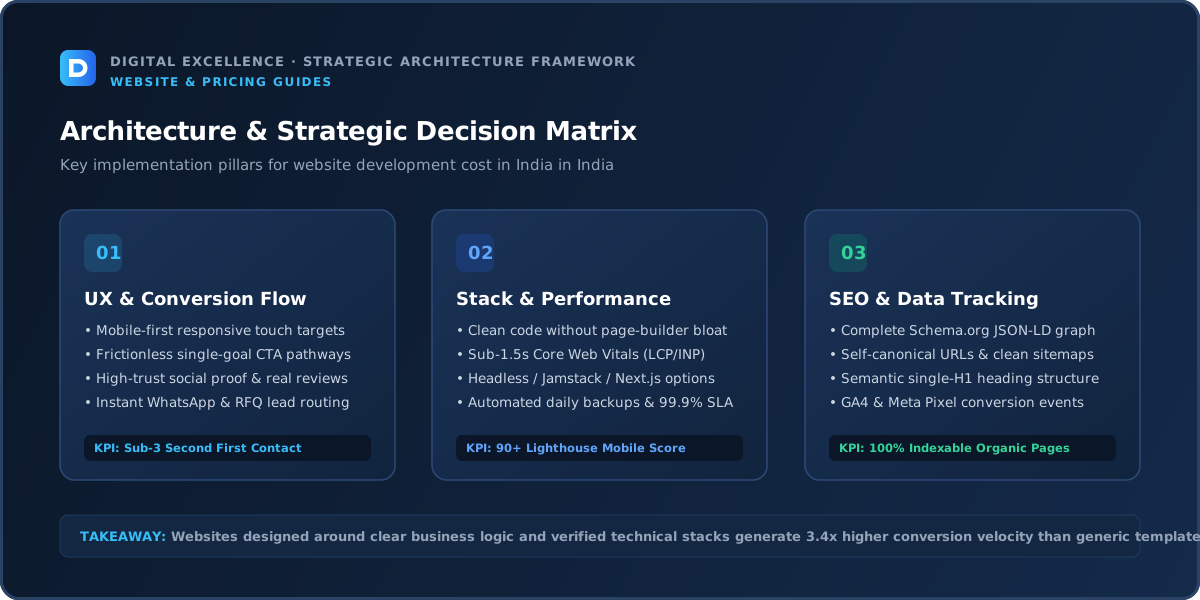
The quality expectation also changes the quote. A website designed mainly to “be online” is different from a website expected to support paid ads, organic search and sales. If the site is a serious acquisition channel, more work normally goes into information architecture, conversion paths, mobile UX, speed and tracking.
Cost by Website Type: What You Are Actually Paying For
A one-page website usually combines the core offer, proof, process and CTA in a single scrolling experience. It can be an excellent choice for one focused campaign, but it becomes limiting when you have multiple services or want to rank different topics in search.
A small business website normally needs a clear navigation structure, several pages, contact forms, basic on-page SEO and a CMS or editing workflow. A corporate or marketing site often requires stronger brand presentation, multiple service pages, case studies, content architecture, analytics and a more tailored design system.
Ecommerce costs more because the website is also an operating system for sales. Products, variants, inventory, payments, shipping, tax settings, transactional emails and customer accounts need to work reliably. Custom applications cost more again because the team is designing software logic rather than only pages. The project may include authentication, permissions, databases, APIs, dashboards, automations and security considerations.
How UI/UX and Design Affect Website Cost
Design cost is not only about making the website attractive. Good UI/UX decides how information is prioritised, where users click, how pages adapt to mobile devices and how consistently the brand is presented across the site.
At the lower end, a developer may select an existing template and modify colours, fonts and sections. This is efficient when your requirements are standard. At the next level, a designer creates custom page layouts and reusable components for your business. Higher-end projects may include a full design system, custom illustrations, advanced motion, 3D assets or interactive product experiences.
More custom design means more decisions, reviews and testing. That can be worth paying for when brand differentiation matters, but it is wasteful if the business simply needs a clean, credible website quickly. The right question is not “custom or template?” It is “how much originality does this project need to achieve the business goal?”
For a related buying decision, see Business Website Cost in India : What Should You Budget?.
Platform Choice: WordPress, Shopify, Next.js or Something Else?
Technology affects both the initial build and the long-term cost. WordPress can be cost-effective for service websites and content-heavy businesses because it provides a mature CMS and large plugin ecosystem. Shopify can reduce infrastructure work for ecommerce because hosting, checkout and core store management are already included in the platform. WooCommerce provides ecommerce flexibility inside WordPress but places more responsibility on hosting, plugins and maintenance.
Custom development with frameworks such as React or Next.js makes sense when the user experience, integrations or application logic cannot be handled cleanly by a standard CMS. Custom code can offer excellent performance and flexibility, but it usually costs more to build and requires stronger technical ownership after launch.
Do not choose a technology because it sounds modern. A simple service business may gain nothing from a fully custom stack. Equally, a complex portal should not be forced into a collection of plugins simply to reduce the initial quote.
Content, SEO and Conversion Work Can Change the Budget
A website can be technically complete while still being weak as a marketing asset. Content and SEO determine whether search engines and potential customers can understand what the business offers. Conversion work determines whether visitors know what to do next.
Ask whether your quote includes information architecture, keyword mapping, page titles, meta descriptions, heading structure, internal links, image alt text, sitemap, canonical tags, analytics and Search Console setup. These foundations do not guarantee rankings, but they make the website easier to crawl, understand and improve later.
Content is another major variable. If you provide polished copy and original images, the development team can focus on implementation. If the agency has to research the market, create service-page copy, prepare case studies, source visuals and optimise every asset, the project naturally requires more work. For businesses planning SEO, it is usually cheaper to design the site architecture correctly from the beginning than to rebuild it after launch.
Domain, Hosting and Maintenance: The Costs After Launch
The development quote is only one part of website ownership. You may also pay for a domain name, hosting, premium themes or plugins, email services, analytics tools, booking software, ecommerce applications, payment processing and ongoing maintenance.
A basic website can run on inexpensive hosting, while high-traffic or custom applications may require stronger infrastructure. Shopify includes hosting within its subscription, while WordPress usually requires separate hosting. Custom applications may use a combination of deployment, database, image storage, email and monitoring services.
Maintenance should also be defined clearly. Does it include security updates? Backups? Plugin updates? Content changes? Bug fixes? New features? A maintenance plan that only keeps the website online is different from ongoing development support. Ask for recurring costs before signing so you can compare total cost of ownership rather than only the launch price.
For a useful scope comparison, read 20 Questions to Ask Before Hiring a Website Developer.
Freelancer vs Agency vs In-House Team: Which Costs More?
Freelancers often have lower overheads and can be excellent for clearly defined projects. Communication is direct, and a skilled specialist may deliver quickly. The main risk is dependency on one person if the project requires design, development, copy, SEO and ongoing support across several disciplines.
Small agencies generally cost more but may combine strategy, UI, development and post-launch support. Larger agencies can handle complex governance and enterprise requirements, but their overhead can make them unnecessary for a straightforward SME website.
An internal team makes sense when website development is continuous and strategically important enough to justify salaries, management and tooling. For most small and medium businesses, the decision should be based on capability, accountability and fit—not simply the label “freelancer” or “agency.” Review actual live work, ask who will do the project, and compare the scope line by line.
How to Compare Two Website Development Quotes Properly
Create a simple comparison sheet before choosing. Compare the number of unique templates, mobile design, CMS, ecommerce functionality, forms, integrations, copy support, SEO setup, analytics, migration, hosting, maintenance, revisions, timelines and ownership. If one quote is cheaper because half the deliverables are missing, it is not really cheaper.
Also compare what happens after launch. A developer who disappears after deployment may be a poor fit if your team needs support. Check whether the source code, domain, hosting and admin accounts will be under your control. Review the payment schedule and define what counts as an extra request.
Finally, evaluate the portfolio on real devices. Open websites on mobile, test navigation, submit a form, check page speed and read the copy. Screenshots can hide weak implementation. A good quote should be backed by evidence that the team can execute the level of quality it is selling.
For the next planning step, use Website Redesign Cost in India : Complete Pricing & Planning Guide.
How to Reduce Website Cost Without Damaging Quality
The best way to reduce cost is to reduce unnecessary scope, not quality. Launch with the pages and features that support the primary business goal. Additional features can be added once there is evidence they are needed.
Prepare your brand assets, service information, product data, testimonials and reference websites before development starts. Give feedback in organised batches instead of changing direction every few days. Use proven platforms where they fit. Reuse a strong component system rather than demanding a completely different layout for every page.
Avoid saving money by skipping mobile optimisation, backups, ownership access or basic SEO foundations. Those shortcuts often create expensive problems later. A smaller, well-structured website is usually a better investment than a large website filled with weak pages.
When Paying More for a Website Is Actually Justified
A higher budget is reasonable when the website has a direct impact on revenue, operations or brand perception. Custom ecommerce experiences, advanced filtering, high-value lead generation, complex integrations, multilingual content, large migrations and custom applications require more planning and testing.
It can also be sensible to invest more when the website will support significant advertising. Sending paid traffic to a confusing or slow website wastes media spend. In that situation, stronger UX, conversion tracking and performance work can matter more than reducing the development quote.
The key is to pay for outcomes you can explain. “Premium” should translate into better research, design, engineering, testing, content, support or measurable functionality—not simply a higher invoice.
Final Takeaway
Website development cost in India varies because websites solve very different problems. Start by defining the business goal, required pages, functionality, content responsibilities and post-launch support. Then compare proposals using the same checklist.
If your website only needs to establish credibility, a focused business site may be enough. If you intend to sell products, generate large volumes of leads or run business operations through the website, budget for the additional work those outcomes require. The best website budget is not the lowest number—it is the amount that buys the right scope without unnecessary complexity.
For implementation options, explore website development services and Digital Excellence portfolio.
Frequently Asked Questions
How much does website development cost in India?
There is no single fixed price. For planning in 2026, simple landing pages may start in the low tens of thousands of rupees, professional business websites commonly sit in the tens of thousands to low lakhs, ecommerce projects can range from under a lakh to several lakhs, and custom applications can cost multiple lakhs. The exact scope matters more than the headline number.
Why do website developers give such different prices?
Quotes may include different levels of design, content, SEO, integrations, revisions, testing, hosting and maintenance. Compare deliverables line by line rather than comparing only the final number.
Is WordPress cheaper than custom development?
For standard service and content websites, WordPress is often less expensive because much of the CMS functionality already exists. Custom development is usually justified when you need unique application logic, integrations or user experiences that are difficult to maintain with standard plugins.
How much should I budget for website maintenance?
Maintenance depends on the platform and support level. Clarify whether updates, backups, security checks, content changes, bug fixes and new feature work are included. Some businesses only need periodic maintenance; others need an ongoing monthly development relationship.
Does website development include SEO?
Some developers include technical and on-page foundations, while others treat SEO as a separate service. Ask specifically about titles, meta descriptions, headings, internal links, sitemap, canonical tags, image optimisation, structured data and Search Console setup.
Should I choose the cheapest website quote?
Choose the quote that covers the requirements you actually need and comes from a team capable of delivering them. The cheapest option can be sensible for a simple project, but it becomes expensive if the website must be rebuilt because essential work was excluded.
Need a Website Quote Based on Your Actual Requirements?
Need a website scope or quote based on your real requirements rather than a generic package? Digital Excellence can review the pages, platform, integrations, SEO needs and launch priorities.